























| Device | Price | Display | Connectivity | Accepts | POS Software | Receipt Printer | APIs | Best For |
|---|---|---|---|---|---|---|---|---|
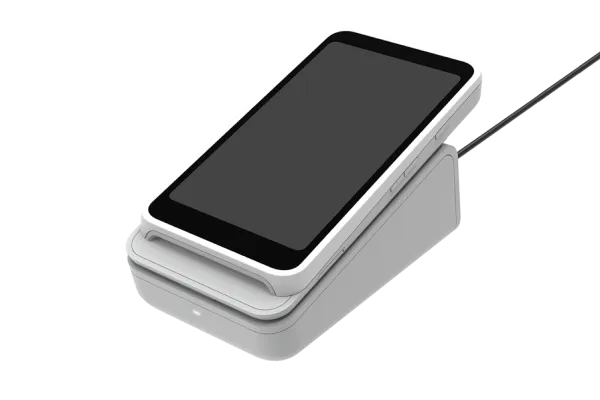
 Helcim Smart Terminal
|
$349 (one-time purchase) | 7″ HD touchscreen | Wi-Fi + built-in 4G (optional $7/month) | Tap, chip, swipe, manual entry | Full POS app pre-loaded — inventory, tipping, receipts, employee logins | Built-in thermal printer | Full Smart Terminal APIs for custom integrations | Businesses wanting a turnkey countertop POS |
 Stripe Reader S700
|
$299 + $49 dock = $348 USD | 7″ HD touchscreen | Wi-Fi + Ethernet + optional 4G ($14/month) | Tap, chip, swipe | No standalone POS — must be driven by your own app or a third-party integration | Available via separate dock purchase (not built-in) | Stripe Terminal SDK for custom in-person flows | Developers embedding in-person payments into custom software |
Helcim vs. Stripe
An honest, side-by-side comparison of pricing, software tools, hardware, and business models — so you can decide which payment processor fits your business.
Helcim vs. Stripe business models
Helcim offers business owners transparent interchange-plus pricing that automatically drops as you grow, with every payment tool included at no extra cost. Stripe is an API-first platform built for developers to embed payments into their own software, with a flat rate per transaction.

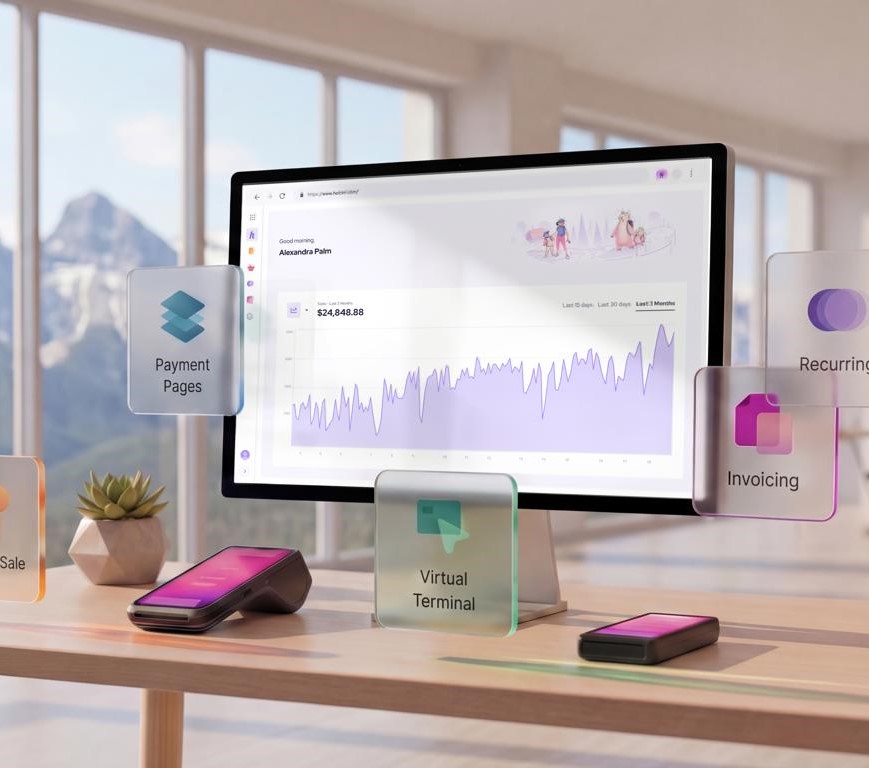
How Helcim's model works
- Helcim uses interchange-plus pricing that passes through true interchange and network fees at cost, then adds a transparent margin on top.
- A fully functional, ready-to-use POS system with no coding required, plus online tools — virtual terminal, invoicing, online checkout links, recurring payments, client management, and inventory tracking — included at zero monthly cost.
- As your monthly card volume grows, Helcim's margin automatically drops by up to 70% with no negotiations.
- There are no monthly fees, no PCI fees, no setup or cancellation fees, no statement fees, and no per-user or per-location charges.

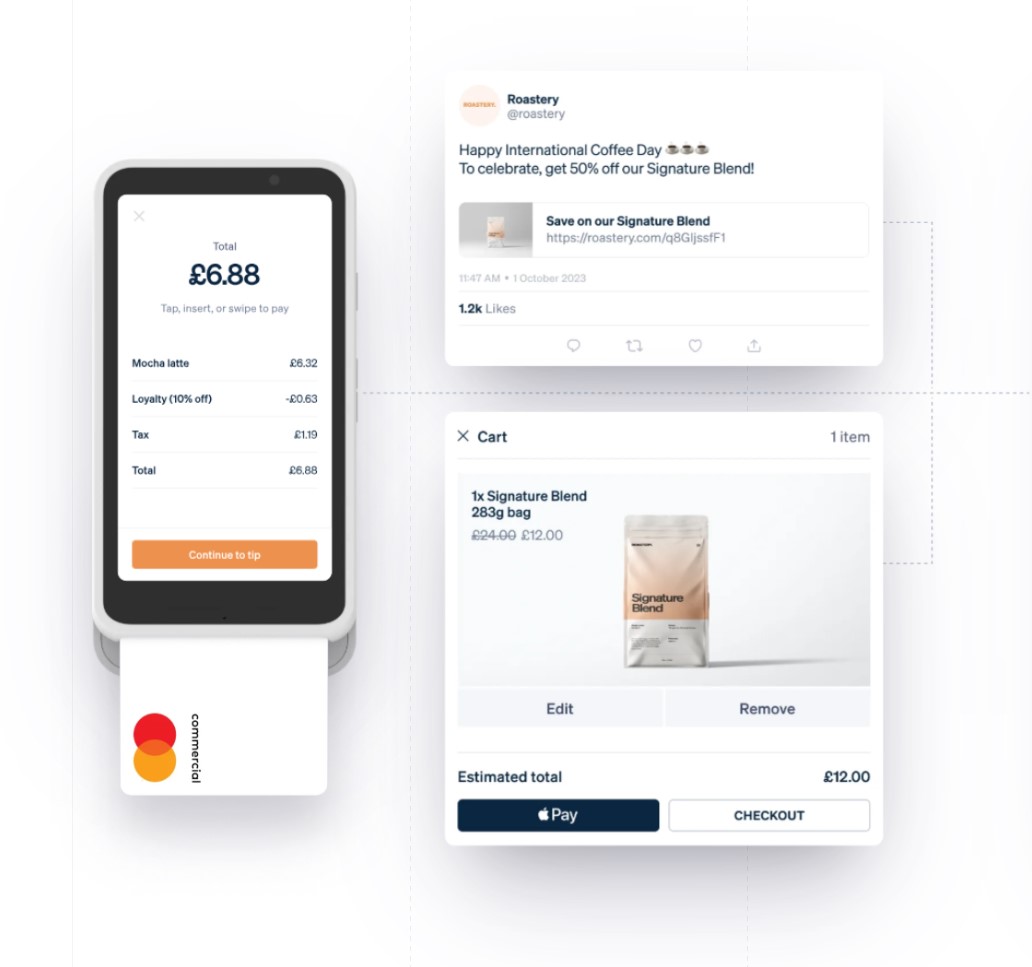
How Stripe's model works
- Stripe uses a flat-rate pricing model that charges 2.9% + 30¢ per online credit card transaction and 3.4% + 30¢ per Virtual Terminal transaction.
- Stripe is an API-first solution. There's no out-of-the-box point-of-sale app or inventory system — you build your checkout with Stripe's SDKs and components, or connect their hardware to a third-party platform.
- Many of Stripe's online payment features include extra software fees on top of standard processing, such as Stripe Billing (subscriptions) or Stripe Invoicing.
- Stripe accepts 135+ currencies and offers a Merchant-of-Record option (Managed Payments) to handle international compliance and tax filing on your behalf.
Helcim vs. Stripe pricing and fees
Compare processing fees, monthly costs, and software add-on pricing side by side. Helcim uses interchange-plus pricing with automatic volume discounts; Stripe uses flat-rate pricing with additional percentage fees for many products.
Pricing Model
Monthly Costs
In-Person Processing
Online Processing
Virtual Terminal
US Common PIN Debit
ACH Processing
Tap to Pay on Phone
Volume Discounts
Invoicing
Point-of-Sale
Recurring Payments
Chargeback Fee
4G Mobile Data
Card Reader
Smart Terminal
Helcim
Interchange-plus
$0
1.79% + 8¢
Average
2.31% + 25¢
Average
2.31% + 25¢
Average
1.00% + 8¢
Average
0.5% + 25¢ (capped at $6)
10¢
Up to 70% discount
Included free
Included free
Extra 0.4% per transaction
$15
$7/month
$199 per unit
$349 per unit
Stripe
Flat-rate
$0
2.7% + 5¢
2.9% + 30¢
3.4% + 30¢
2.7% + 5¢
1% + 40¢ (capped at $5)
15¢
Custom enterprise only
Extra 0.4% per invoice
N/A
Extra 0.7% per charge
$30
$14/month
$59
$349 per unit
| Provider | Pricing Model | Monthly Costs | In-Person Processing | Online Processing | Virtual Terminal | US Common PIN Debit | ACH Processing | Tap to Pay on Phone | Volume Discounts | Invoicing | Point-of-Sale | Recurring Payments | Chargeback Fee | 4G Mobile Data | Card Reader | Smart Terminal |
|---|---|---|---|---|---|---|---|---|---|---|---|---|---|---|---|---|
|
|
Interchange-plus | $0 | 1.79% + 8¢ Average | 2.31% + 25¢ Average | 2.31% + 25¢ Average | 1.00% + 8¢ Average | 0.5% + 25¢ (capped at $6) | 10¢ | Up to 70% discount | Included free | Included free | Extra 0.4% per transaction | $15 | $7/month | $199 per unit | $349 per unit |
|
|
Flat-rate | $0 | 2.7% + 5¢ | 2.9% + 30¢ | 3.4% + 30¢ | 2.7% + 5¢ | 1% + 40¢ (capped at $5) | 15¢ | Custom enterprise only | Extra 0.4% per invoice | N/A | Extra 0.7% per charge | $30 | $14/month | $59 | $349 per unit |
The bottom line
Helcim's interchange-plus model typically saves small and mid-sized businesses money, especially as volume grows. Stripe's flat rate is predictable and simple, but it doesn't decrease with scale unless you negotiate a custom enterprise deal.
Helcim uses an interchange-plus pricing model that passes the true transaction fees charged by banks and payment networks to merchants. These true fees vary every transaction. Average fees are based on common credit cards, excluding American Express, and an average transaction amount of $300.
Helcim vs. Stripe software feature comparison
All Helcim software tools are available at no additional cost. Stripe offers powerful building blocks, but many of them are separate products with their own percentage fees that stack on top of processing. Pick a tool to see the full comparison.
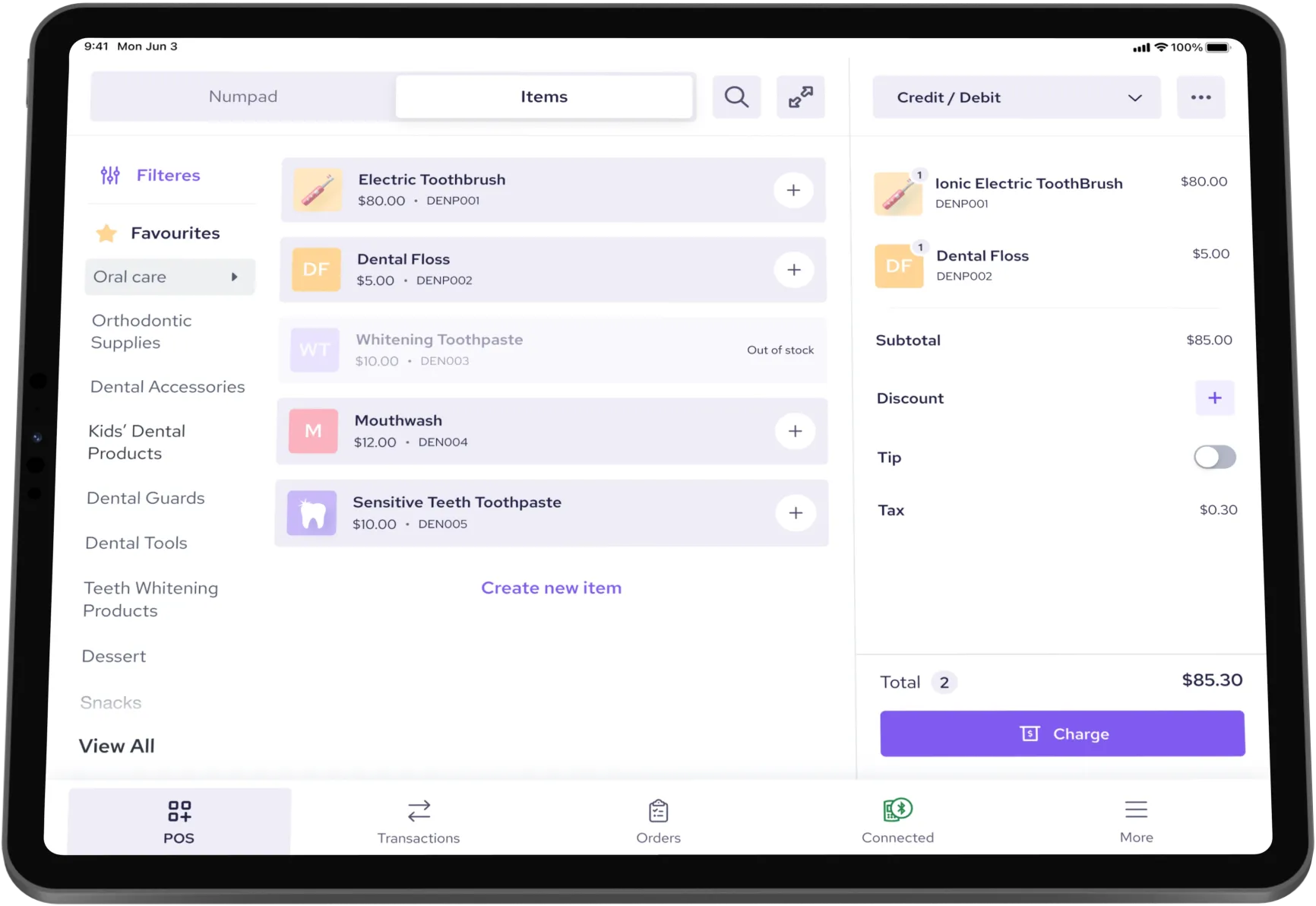
Helcim POS
A full point-of-sale app pre-loaded on Helcim terminals. Supports catalogues, tipping, split payments, tap/chip/swipe, and employee logins.
- Free POS software — no monthly fee
- Pre-loaded on Smart Terminal & Card Reader
- Multi-location support at no extra cost
Stripe Terminal
Stripe Terminal provides SDKs and pre-certified readers so developers can build custom in-person payment flows into their own apps.
- No standalone POS app — requires custom development
- Hardware must be driven by your own software or a third-party POS
- Best for dev teams embedding payments into existing platforms
What both offer
Both let you accept in-person card payments through compatible hardware. Both have receipts and reporting.
The bottom line
Helcim is the better choice if you want a ready-to-go POS without writing code. Stripe is better if you're a developer building payments into your own software.
Helcim Virtual Terminal
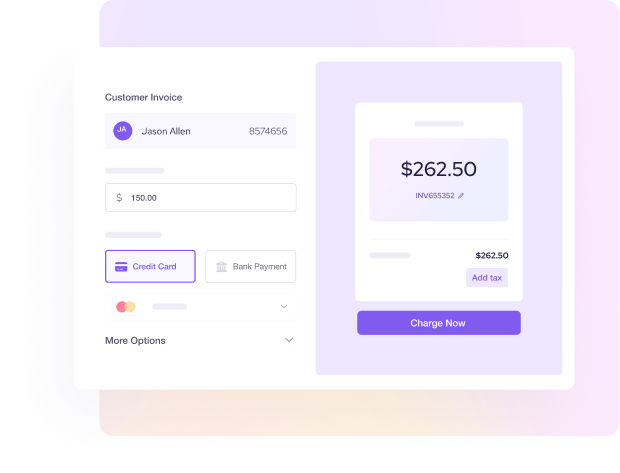
A built-in web-based terminal accessible from any browser. Key in cards for phone/mail orders, apply discounts, and store customer cards on file.
- Included free — no monthly fee
- Customer vault and card-on-file support
- Integrated with invoicing, CRM, and reporting
Stripe Dashboard
Stripe allows manual payment creation through the Dashboard for one-off charges. However, Stripe charges an extra +0.5% on top of its standard 2.9% rate for virtual terminal / keyed-in transactions, bringing the total to 3.4% + 30¢.
- Extra +0.5% surcharge on keyed-in transactions (3.4% + 30¢ total)
- Full-featured flows require developer integration
- No dedicated standalone virtual terminal interface
What both offer
Both allow manually keying in card numbers for phone or mail orders.
The bottom line
Helcim offers a purpose-built virtual terminal for phone/mail orders at no extra fee. Stripe adds an extra +0.5% surcharge on top of its standard rate for keyed-in transactions, making it significantly more expensive for MOTO operations.
Helcim Invoicing
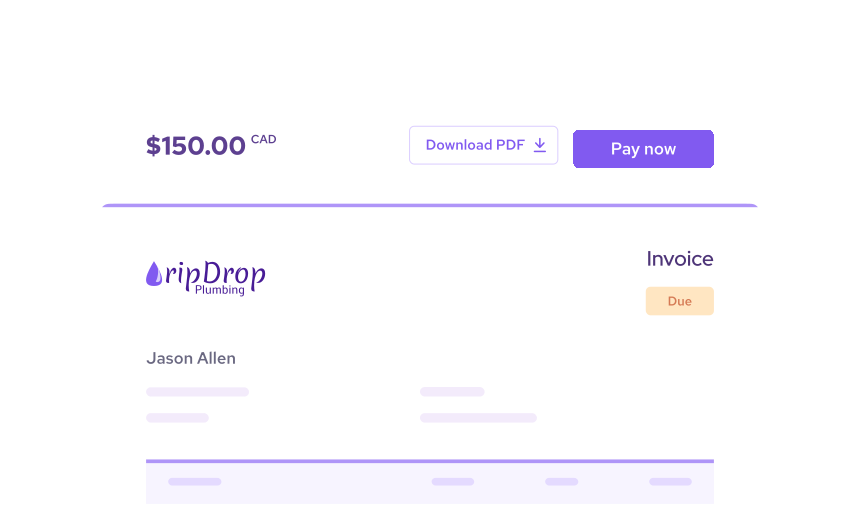
Create, send, and track invoices from your Helcim account. Add line items, set due dates, enable online payment, and automatically reconcile paid invoices.
- Included free — no monthly or per-invoice fee
- Online payment link embedded in every invoice
- Auto-reconciliation with your transaction history
Stripe Invoicing
A standalone Stripe product for creating and sending invoices. Includes hosted payment pages and reminders.
- Additional fee: 0.4% per paid invoice (on top of processing)
- Hosted payment page with multiple payment methods
- Revenue recognition and accounting integrations
What both offer
Both let you create and send invoices to customers with embedded payment links.
The bottom line
Helcim includes invoicing free. Stripe charges an additional 0.4% per paid invoice on top of your processing rate.
Helcim Online Checkout
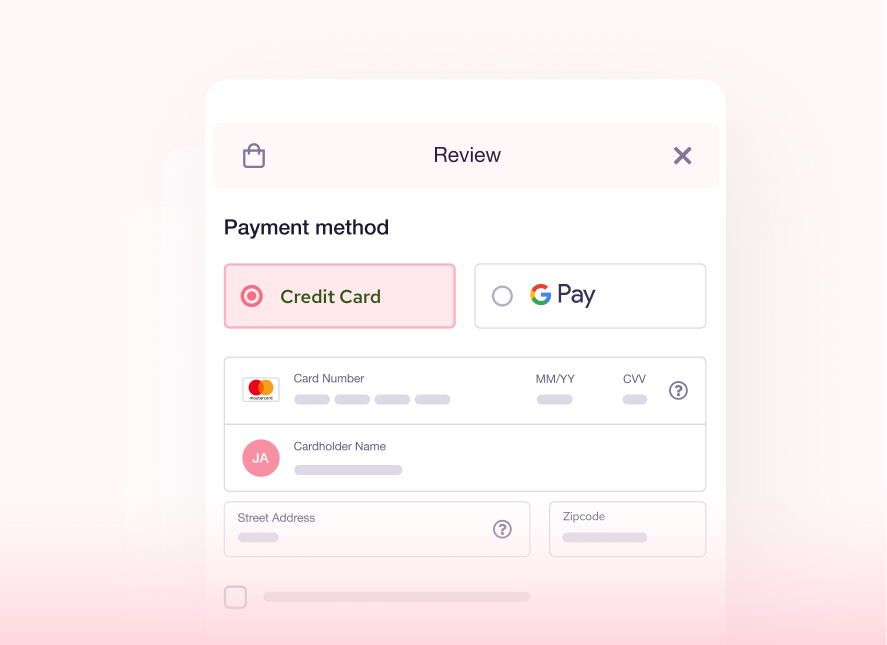
Payment pages, buy buttons, and shareable links — no coding required. Includes HelcimPay.js for developers who want deeper integration.
- Included free — no additional software fee
- No-code payment pages and embeddable buy buttons
- HelcimPay.js SDK for custom developer integrations
Stripe Checkout & Payment Links
Pre-built checkout pages and no-code payment links. For deeper customization, Stripe Elements lets developers build bespoke checkout flows.
- Payment Links included at standard processing rate
- Stripe Elements for fully custom checkout UIs
- Supports 135+ currencies and dozens of payment methods
What both offer
Both offer embeddable checkout experiences for your website or online store.
The bottom line
Both offer strong online checkout options. Stripe has more global payment methods and deeper UI customization. Helcim provides simpler no-code tools at no additional fee.
Helcim Recurring Payments
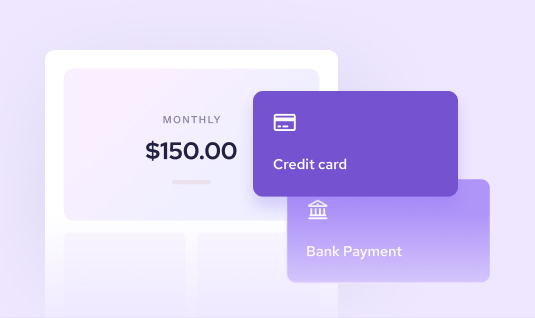
Set up recurring billing plans with flexible schedules. Automatically charge saved cards at defined intervals. Helcim adds +0.4% for recurring transactions.
- Small +0.4% surcharge for recurring transactions
- Flexible billing intervals (weekly, monthly, annual)
- Integrated with customer vault and invoicing
Stripe Billing
A full-featured subscription management platform with metered billing, prorations, trials, coupons, and usage-based pricing. Stripe adds 0.7% per recurring charge.
- Additional fee: 0.7% per recurring charge (on top of processing)
- Advanced metered/usage-based billing support
- Revenue recognition via Stripe Revenue Recognition
What both offer
Both support storing cards on file and charging customers on a recurring schedule.
The bottom line
Helcim charges +0.4% for recurring transactions, while Stripe charges 0.7% — nearly double. Stripe Billing is more feature-rich for complex SaaS subscription models, but comes at a higher cost.
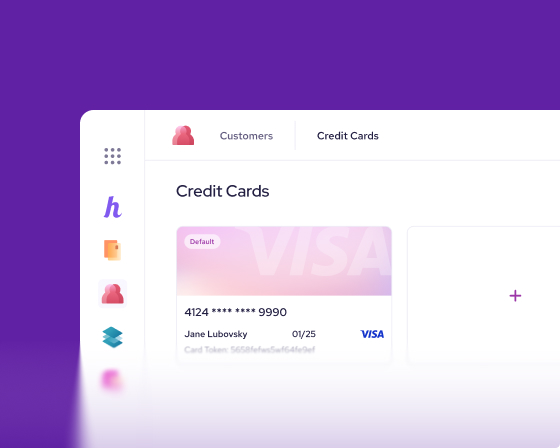
Helcim Customer Manager
A built-in CRM to manage contacts, view transaction history, store cards and bank accounts securely, and track customer lifetime value. Helcim also includes a free customer portal for self-service.
- Included free — integrated across all Helcim tools
- Secure card + bank account vault (PCI Level 1 compliant)
- Free customer portal for self-service account management
Stripe Customers
Stripe's Customer object stores payment methods and billing details, primarily for developer use via API.
- API-driven customer management
- Secure card + bank account storage
- Customer portal for self-service billing (add-on)
What both offer
Both providers support card vault and bank account vault for securely storing payment methods.
The bottom line
Both offer card and bank account vaulting. Helcim provides a user-friendly CRM with a free customer portal for self-service. Stripe's customer management is powerful but designed for developer access via API, and its customer portal is an add-on.
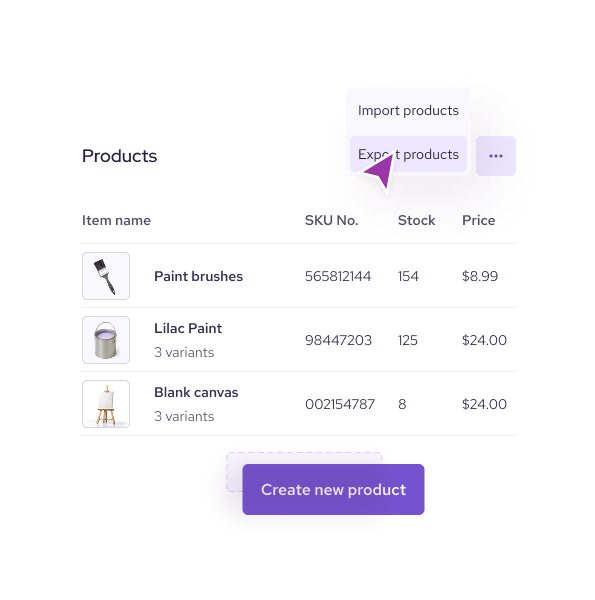
Helcim Inventory
Built-in product catalog and stock tracking across locations. Syncs with POS, online checkout, and invoicing.
- Included free — no per-SKU fees
- Multi-location inventory tracking
- Syncs across POS, invoicing, and online checkout
Stripe Products
Stripe's Product and Price objects define what you sell, but there's no built-in inventory tracking. Stock management requires third-party integrations.
- Product and price catalog for checkout and billing
- No native stock-level tracking
- Requires external system for inventory management
What both offer
Both can track products and pricing for use in payment flows.
The bottom line
Helcim includes inventory management. Stripe has no native stock tracking — you'll need a separate system.
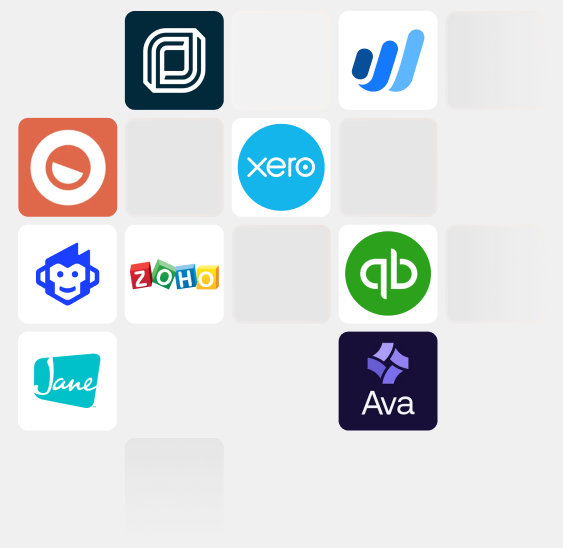
Helcim Integrations
Helcim's Payment Extension is rapidly adding popular SaaS integrations, letting merchants embed Helcim payments directly into the software they already use — and merchants can request new integrations. Helcim also connects with QuickBooks, WooCommerce, and offers a full API and HelcimPay.js for developers.
- Payment Extension: quickly growing list of popular SaaS integrations
- Merchants can request new integrations directly
- QuickBooks, WooCommerce, Helcim API, and HelcimPay.js
Stripe Integrations
Stripe has a large integration ecosystem connecting with thousands of platforms, along with well-documented APIs and developer tools.
- Thousands of integrations across many categories
- Comprehensive API documentation and SDKs
- Stripe Apps marketplace for extending the Dashboard
What both offer
Both integrate with popular business platforms and provide APIs for custom development.
The bottom line
Stripe has a larger integration catalog today, but Helcim's Payment Extension is quickly closing the gap by adding popular SaaS integrations — and merchants can request the ones they need.
Helcim vs. Stripe hardware comparison
For each device matchup, compare specs side by side. A key theme: Helcim's devices run a ready-to-use POS out of the box, while Stripe's readers are designed to be driven by software you build or connect.
Head-to-head
Both devices share a similar screen size, but the Helcim Smart Terminal comes with a fully functional POS pre-loaded, a built-in receipt printer, and built-in 4G at $7/month. The Stripe S700 requires a separate dock for printing and costs $14/month for data. Both offer full APIs for custom integrations.
| Device | Price | Connectivity | Accepts | Standalone Mode | POS Software | APIs | Battery | Best For |
|---|---|---|---|---|---|---|---|---|
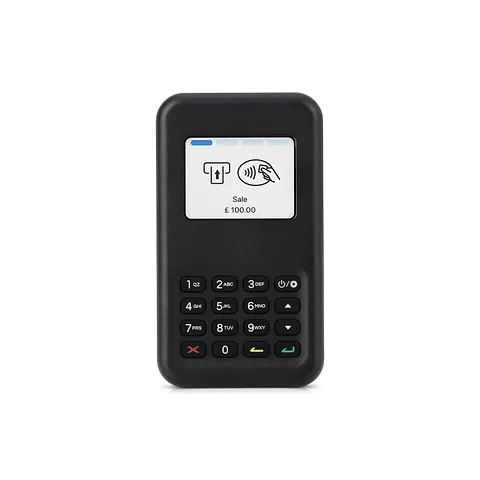
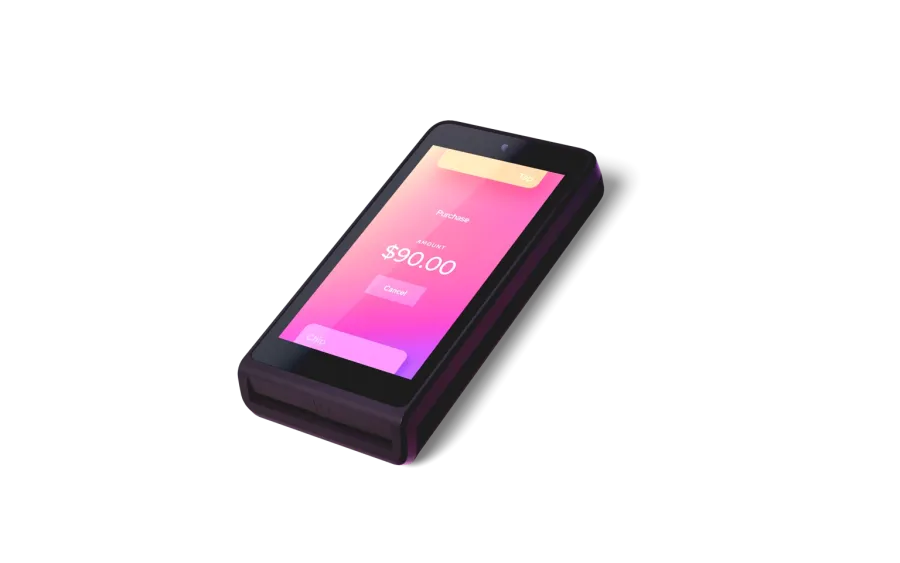 Helcim Card Reader
|
$199 (one-time purchase) | Wi-Fi + built-in 4G (optional $7/month) | Tap, chip, and PIN | Yes — enter amount and process without pairing to a phone or app | Pairs with Helcim POS app, mobile apps, tablets, workstations, and Payment Extensions for existing software | Full APIs for custom integrations | Built-in rechargeable battery, all-day use | Fleets, mobile businesses, affordable countertop chip & PIN, and standalone on-the-go payments |
 BBPOS WisePad 3
|
$59 USD (one-time purchase) | Bluetooth to your own app or supported third-party POS | Tap and chip | No — must always be paired to an app | No standalone app — must pair with your own software or an integration | Stripe Terminal SDK | Built-in rechargeable battery | Developers adding tap-to-pay to mobile apps |
Head-to-head
The BBPOS WisePad 3 is cheaper upfront, but it requires Bluetooth pairing to your own app at all times. The Helcim Card Reader features Wi-Fi, built-in 4G, and a unique standalone mode — enter an amount and process a payment without needing a phone or app. It's ideal for fleets, pop-ups, and as an affordable countertop chip & PIN solution.
Where each platform shines
Both Helcim and Stripe are strong payment platforms — but they're built for different types of businesses. Here's an honest look at where each one excels.
You want low, transparent pricing
Helcim's interchange-plus model passes the exact wholesale cost charged by the banks directly to you, plus a transparent markup on top.
You're growing
Your processing rate drops automatically as your sales volume rises (saving you up to 70% off Helcim's markup). Stripe's standard flat rate doesn't fall unless you negotiate a custom enterprise contract.
You don't want per-product fees stacking up
Except Helcim Recurring Payments, all other Helcim online payment tools are accessible at no extra cost or monthly fees. You only pay payment processing fees.
You want every tool ready with no code
Helcim POS, Invoicing, Online Store, Recurring Billing, Virtual Terminal, CRM, and Inventory Management work out of the box — no developer required.
You want human support
Helcim is known for amazing and friendly customer service. Reach real humans by phone, email, or chat — no bots, no phone trees, no ticket queues. The support team genuinely cares about helping merchants succeed.
A developer-first platform
If you're building software, Stripe's APIs and SDKs are robust — they let you build a custom payment flow and experience that matches your business model.
Global reach and Merchant of Record
Stripe supports 135+ currencies and many countries, and its Managed Payments option can act as Merchant of Record to handle international sales tax and compliance for you. Helcim serves only businesses in the U.S. and Canada.
Advanced, usage-based subscription billing
Stripe Billing handles metered/usage-based pricing that goes well beyond standard recurring billing.
Marketplaces and platforms
Stripe Connect is purpose-built for platforms and marketplaces, so they can navigate complex payment flows and revenue shares between multiple buyers and sellers.
Online-first product optimization
Checkout, Payment Links, Elements, Link, Radar fraud scoring, adaptive acceptance, and a wide range of alternative payment methods make Stripe a strong option for large and enterprise businesses.
When to choose Helcim vs. Stripe
Helcim and Stripe are built for fundamentally different businesses. Helcim is designed for growing small and mid-sized businesses that want transparent pricing, ready-to-use tools, and no hidden fees. Stripe is built for developer-led startups and global enterprises that need deep API customization and international scale.

You want transparent interchange-plus pricing that drops automatically as your business grows, you need to accept payments instantly in person or online without writing code, and you want a full set of online payment tools with no per-product or monthly software fees.
You have a dedicated development team, need to sell globally in 135+ currencies, prefer highly customizable APIs to build entire checkout flows, or require marketplace and platform payment infrastructure like Stripe Connect.
Frequently asked questions
For most small and mid-sized businesses, yes. Helcim uses interchange-plus pricing, which passes through the actual wholesale cost of each transaction plus a transparent margin. Stripe charges a flat rate of 2.9% + 30¢ per online transaction, which is typically higher — especially as your volume grows. With Helcim, your rates automatically drop as you process more.
No. Helcim has no monthly fees, no setup fees, no cancellation fees, and no PCI compliance fees. You only pay processing fees when you accept a payment. Stripe also has no monthly fee for its standard product, but many add-on tools (Billing, Invoicing, Tax, etc.) come with additional percentage-based fees.
Yes. Helcim offers a REST API and helcim.js SDK for custom payment integrations. However, if you need advanced developer tools like metered billing, Stripe Connect for marketplaces, or deep checkout customization, Stripe's developer platform is more extensive.
Stripe offers Terminal hardware (Reader M2 and Reader S700), but there is no standalone Stripe POS app. You need to either build your own checkout experience using Stripe's Terminal SDK or use a third-party POS that integrates with Stripe. Helcim provides a fully functional POS app pre-loaded on its terminals.
It depends on your needs. Stripe excels at complex online checkout flows with 135+ currencies, advanced fraud detection (Radar), and dozens of alternative payment methods. Helcim offers simpler no-code checkout tools at no additional software cost, with transparent interchange-plus pricing that saves most businesses money on processing fees.
Yes. Helcim's Merchant Buyout Program helps you transition from other processors. If you're locked into a contract or proprietary hardware, Helcim may cover up to $500 in cancellation fees to help you switch.
Helcim serves businesses in the U.S. and Canada and can accept payments from international cards. However, Helcim does not operate as a Merchant of Record for international tax compliance. If you need to sell globally in 135+ currencies with automated tax filing, Stripe is the better choice.