
























Patient no-shows and last-minute cancellations can leave expensive gaps in your schedule and create avoidable revenue loss. Appointment deposits help solve both problems by creating financial commitment before the visit takes place. In this guide, you'll learn when healthcare clinics should require deposits, how much to charge, how to handle cancellations and refunds, and how to implement a patient-friendly deposit policy that protects your practice without creating unnecessary friction.
First, what are patient payment deposits?
An appointment deposit is a partial payment collected from a patient before their scheduled visit to secure their time slot. It's typically applied toward the final bill at checkout — or forfeited if the patient no-shows without adequate notice.
Think of it the same way a hotel holds a room with a credit card: the money isn't a punishment, it's a commitment device. A deposit flips the dynamic — the patient has already committed money, so the financial incentive works before the appointment, not after it. That's very different from a no-show fee, which requires you to chase down someone who has already demonstrated they didn't prioritize the appointment. One is proactive; the other is a collection problem.
Deposits can take a few forms in practice:
1. Flat-fee deposit — A fixed dollar amount (e.g., $50 to hold any new-patient appointment). Simple to explain and easy to enforce.
2. Percentage-based deposit — A slice of the estimated total, typically somewhere between 25% and 50% of the total service price. Works well for high-cost procedures where the financial exposure is larger.
3. Card-on-file hold— No money changes hands upfront, but a card is stored securely so a fee can be charged if the patient no-shows. More on this below.
What's the difference between the old and new reimbursement model — and why does it matter for deposits?
The short answer: in the old model, clinics collected most of their revenue from insurers. In the new model, patients are picking up a much bigger share of the tab — which makes front-end collection practices, like deposits, far more important.
The old way
Historically, the healthcare reimbursement model was built on a relatively simple idea: the provider renders a service, the insurer pays for it, and the patient's out-of-pocket exposure is small and predictable (a $20 copay, say). Clinics could budget around steady insurance receivables without worrying too much about individual patient collections. Missing an appointment was annoying but not catastrophic.
The new reality
That math has changed significantly. In 2024, 27% of covered workers are enrolled in a high-deductible plan with a savings option, meaning a meaningful chunk of your patient population owes real money before their insurance kicks in at all. The median annual deductible for private industry workers participating in HDHP plans was $2,750 in 2024, according to the U.S. Bureau of Labor Statistics. When patients are responsible for thousands of dollars before their coverage activates, collecting after the fact becomes exponentially harder.
The downstream effect is significant: the total financial loss attributed to patient no-shows in the U.S. healthcare system is estimated at $150 billion per year, and each missed appointment carries an average cost of $200 or more. Deposits don't solve every collection problem, but they move the financial commitment to a moment when the patient is engaged and motivated — which is exactly when it's easiest to collect.
What types of deposits should healthcare clinics collect before an appointment?
Not every appointment warrants a deposit. The goal is to target the situations where a no-show costs your practice the most. Here are the appointment types most practices should consider:
New patient appointments
New patients have no established relationship with your clinic and no sunk cost. On average, medical groups see 43 new patients failing to show up for their appointments each month. A modest deposit — even $25–$50 — creates meaningful skin in the game for first-time bookers.
Long or high-complexity appointments
One effective way to ensure patients stick to their appointments is by requiring a deposit for procedures longer than an hour. When a provider has blocked two hours for a root canal, a sleep study, or a multi-step procedure, the opportunity cost of a no-show is simply too high to absorb.
High-cost elective or cash-pay procedures
For procedures with large price tags — cosmetic treatments, elective imaging, cash-pay wellness services — a percentage-based deposit protects against significant revenue loss and also signals to the patient that this is a real financial commitment.
Patients with a history of no-shows
Make exceptions for reliable patients or emergencies, and evaluate each case to maintain goodwill and trust. Flip that around: patients with a documented pattern of missed appointments are excellent candidates for a deposit requirement every time they book.
Specialty appointments with long lead times
Average no-show rates vary widely by specialty: sleep clinics (39%), pediatrics (30%), dermatology (30%), neurology (26%), and oncology (25%) are all well above the average. If you're in one of these categories and you have a 4–6 week booking backlog, a no-show doesn't just lose revenue — it locks out another patient who needed that slot.
What are the pros and cons of requiring deposits for healthcare appointments?
Deposits are genuinely useful, but they're not magic. Here's an honest rundown.
Advantages
1. Reduced no-shows - Practices that charge a no-show fee reported more improvement in no-show rates in 2024 (25%) compared to practices without a no-show fee (16%), according to MGMA. Deposits work even more proactively by creating commitment before the appointment date.
2. More predictable revenue - When you collect a portion of the payment at booking, your cash flow is smoother and your receivables are easier to forecast — especially important for small independent practices.
3. Fewer last-minute scrambles - Patients who have paid are more likely to give advance notice if they need to cancel, giving you a fighting chance to fill the slot. The result physicians report: patients who are more faithful about showing up, or at least giving notice if they can't.
4. Better patient commitment - A client who has paid a deposit is showing that they are already committed to your clinic, enabling you to feel comfortable giving valuable consultation time.
Disadvantages (what to keep in mind)
1. Potential patient friction - This is especially likely if patients are regulars who have been used to walking in or paying only on the day of — some may be caught off guard or think deposits are an inconvenience. The fix is clear, friendly communication (more on that below).
2. Complexity for insured patients - Deposits can create billing headaches if they're not properly reconciled against insurance payments. You'll need clear internal processes.
3. Medicaid and contract restrictions - If you accept Medicaid, review your provider agreement carefully — some state Medicaid programs prohibit or restrict advance payments from Medicaid beneficiaries. When in doubt, consult a healthcare attorney.
4. Staff training is required - Your front desk needs to be confident and consistent when asking for deposits. If the policy is applied inconsistently, patients will notice — and push back.
How much of a deposit should healthcare clinics collect before a medical appointment?
The sweet spot: enough to create real commitment, not so much that patients abandon the booking. Deposits typically range from $25 to $50 for standard appointments, or a percentage of the overall treatment cost for more expensive procedures — the amount should be enough to encourage attendance but not so high that it deters bookings.
Here's a practical framework by appointment type:
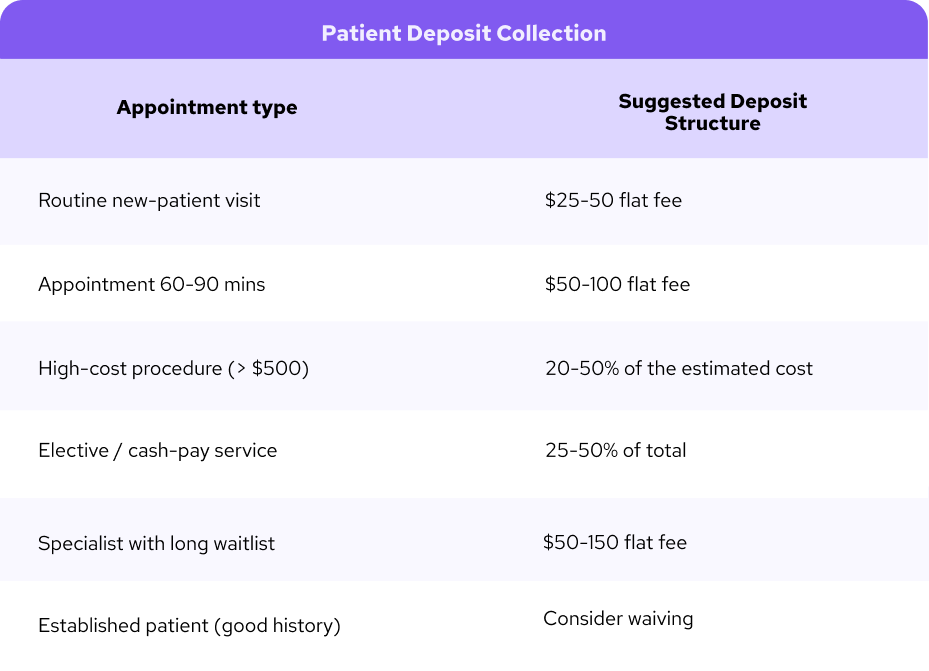
In primary care, fees might range from $25 to $50, while surgical settings may warrant higher fees or deposits due to operating room time and staff scheduling being more resource intensive.
A few practical rules of thumb:
- Always apply the deposit toward the patient's final bill (not on top of it). Patients are far more accepting when they understand it's pre-payment, not a penalty.
- State your deposit amount clearly at the time of booking, in the confirmation email, and in any appointment reminders.
- A small deposit, like $75 or $100, encourages commitment without being burdensome — most patients understand and appreciate this policy, especially when it goes towards their final bill.
How should clinics handle reschedules, late arrivals, or no-shows?
Having a deposit policy is one thing. Knowing what to do with it when something goes sideways is where most clinics get tripped up. Here's a clear framework.
Reschedules with adequate notice
If a patient calls to reschedule and gives you enough lead time to fill the slot, roll their deposit forward to the new appointment. This is both fair and good patient relations — you're not penalizing responsible behavior. Requiring 24 to 48 hours' notice for cancellations is a common and reasonable standard for avoiding a fee. Many practices use 48 hours for longer procedures and 24 hours for shorter ones. Whatever you choose, write it down and communicate it clearly.
Last-minute cancellations
If a patient cancels inside your notice window, you have options: forfeit the deposit entirely, retain a portion of it, or apply it to a future appointment with conditions. Many practices retain 50% for late cancellations and 100% for true no-shows. The key is that your policy states this in writing, and the patient acknowledged it at booking.
No-shows (zero notice)
Forfeit the deposit. This is the whole point. The deposit is generally waived in the event of a true emergency, or if the patient gives ample notice — usually 24 to 48 hours. Use your judgment on genuine emergencies (hospitalization, family crisis), and document your decision for consistency.
Late arrivals
This one's trickier. A patient who arrives 20 minutes late for a 30-minute appointment may not be able to be seen. Decide in advance: do you apply the deposit toward a rescheduled visit, or is it forfeited? Having a written policy eliminates the awkward case-by-case negotiation at the front desk.
Chronic no-show patients
Track cancellations and no-shows in patient records to identify patterns — this enables targeted outreach or alternative scheduling solutions. Some practices move repeat no-showers to same-day-only scheduling, require larger deposits, or (in persistent cases) discharge the patient from the practice.
How should clinics handle refund requests for prepaid deposits?
Refund requests should be handled with a clear policy — and a fair one. Here's a simple decision tree:
Refund in full when:
- The patient cancelled with adequate notice (per your stated policy)
- The appointment was cancelled by your clinic (staff illness, scheduling error, etc.)
- A genuine documented emergency prevented attendance
Retain the deposit when:
- The patient no-showed with no notice
- The patient cancelled inside your stated cancellation window without an emergency reason
Apply toward the balance when:
- The patient showed up — the deposit just counts as a pre-payment at checkout
Things to keep in mind:
-
If you collected the deposit by credit card, issue the refund back to the same card. Refunds typically appear within 3–5 business days depending on the patient's bank. Always confirm the refund in writing (a simple email is fine) so there's no dispute later.
-
Businesses can legally charge appointment deposits and cancellation fees to mitigate losses from no-shows, but fees must comply with state laws, which often limit unreasonable charges. If your deposit amounts feel punitive rather than compensatory, it's worth a quick review with your legal or compliance team — especially if you're in a state with strong consumer protection laws.
How can clinics create and process deposits with Helcim?
Collecting deposits doesn't have to mean an awkward phone call where your receptionist nervously reads out a policy statement and then asks for a card number. With the right setup, it's a clean, professional part of the booking experience.
Here's how clinics use Helcim to handle deposits from end to end:
Step 1: Collect the deposit at booking
-
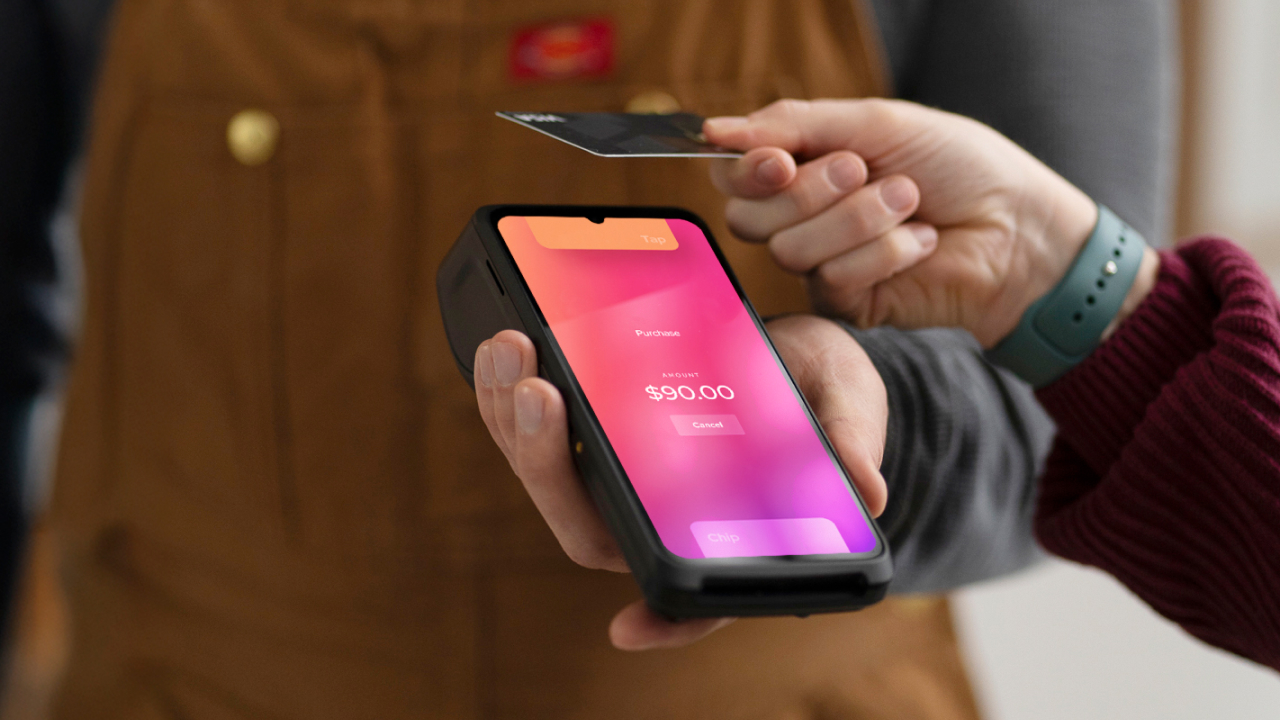
When a patient calls to book, your front desk can use the Helcim Virtual Terminal or Helcim Payment Extension to take the deposit payment right then and there — over the phone, on a tablet, or at the desk. No card reader required, and the process takes about 30 seconds.
-
Alternatively, send the patient a Helcim Payment Page or Online Invoice with the deposit amount, and let them pay on their own before the appointment. This works especially well for online bookings or clinics that confirm appointments via email.
Step 2: Store the card securely for future charges
-
Once a patient pays their deposit, their card is automatically tokenized and saved to the Helcim Secure Card Vault. Helcim securely tokenizes credit card data, eliminating the need for you to store sensitive information, while still giving you access when you need — this not only reduces your risk but also ensures PCI compliance at no cost.
-
Your staff can use stored cards to collect authorized charges such as past due invoices, no-show fees, late cancellation fees, copays, deductibles, or coinsurance — all without having to ask the patient for their card again. This is also the foundation for a card-on-file workflow (see FAQ below).
Step 3: Apply the deposit at checkout
- At checkout, pull up the patient's record, enter the total amount owed, and apply the deposit as a partial payment. The balance is charged to the card on file, or the patient pays the remainder by their preferred method.
Step 4: Process no-show forfeitures
- If the patient no-shows, the deposit is simply retained. If you've collected the deposit upfront, no additional action is needed — the funds are already in your account. If you're using a card-on-file hold instead, charge the no-show fee through the Virtual Terminal against the stored card.
- Helcim's healthcare payment tools are built with HIPAA compliance in mind. Helcim operates a rigorous HIPAA compliance program designed to protect your PHI, including conducting an annual review of internal controls — you can review and request the full audit report at trust.helcim.com, and Helcim also offers healthcare merchants Business Associate Agreements (BAAs) on request.
- For clinics that want to use transparent, low-cost processing, Helcim uses interchange-plus pricing — meaning you pay the actual cost of each transaction plus a small markup, with no hidden fees or monthly minimums.
Ready to put your deposit policy to work?
Collecting appointment deposits doesn't require new software, a new policy binder, or a week-long staff training. With Helcim, you can start collecting deposits over the phone today — and build a card-on-file workflow that handles no-show charges, post-visit balances, and copays all in one place, with no monthly fees and no contracts.
Create your free Helcim account and see how straightforward protecting your schedule can be. If you'd like to talk through your specific clinic setup, reach out to the Helcim team — there are real humans here that will always be happy to help and show you around.
FAQs
Should clinics collect deposits for insured patients as well as self-pay patients?
Yes — with important caveats. A no-show deposit is not a fee for a medical service; it's a fee for a missed business opportunity, which means different rules apply. If a physician's or supplier's missed appointment policy applies equally to all patients (Medicare and non-Medicare), then Medicare law and regulations do not preclude the physician or supplier from charging the Medicare patient directly, per CMS guidance. However, if you accept Medicaid, check your state's provider agreement — some states restrict advance collections from Medicaid beneficiaries. For commercially insured patients, deposits are generally permissible as long as they're not billed to the insurer and are disclosed to the patient upfront. When in doubt, consult a healthcare attorney familiar with your state's rules.
How should clinics explain deposit policies to patients?
Lead with the "why" not the "what". Patients respond well to transparency. Explaining the idea behind the deposit to patients helps — one physician emphasizes that the aim is to open otherwise unused appointments for patients, not to collect missed appointment fees. A simple script works well: "We require a small deposit to hold your appointment time — it goes toward your visit cost and helps us keep our schedule available for all patients." Put the policy in your booking confirmation, in your appointment reminder, and on your website. Including the policy in appointment reminders and prominently displaying it on the practice website reduces surprise and promotes compliance.
Should a deposit be refunded if the final bill is lower than expected?
Yes. A deposit is a pre-payment toward services, not a separate charge. If the final bill after insurance processing comes out lower than the deposit collected, the patient is entitled to a refund of the difference. Issue it promptly — ideally at checkout when the final balance is settled. If insurance takes time to adjudicate, process the refund as soon as the final balance is confirmed. Handling this proactively builds trust and dramatically reduces the likelihood of a chargeback. What should clinics do when a patient asks for a refund of a prepaid deposit? First, check whether the request falls within your stated policy: Did the patient give adequate notice? Was there a documented emergency? If yes, refund in full. If not, apply the policy consistently — but with grace. If there are gray areas (a patient who rarely no-shows and has a plausible excuse), the goodwill value of a one-time refund usually outweighs the deposit amount. Whatever you decide, document it in the patient's account notes. Consistency protects you if a dispute escalates.
Can clinics process deposits using card-on-file payments?
Yes, and it's one of the most efficient approaches. Rather than collecting cash upfront, you take the patient's card at booking and store it securely. Healthcare clinics should use a secure payment vault — such as Helcim Card Vault — with tokenization to store patients' credit cards on file, and should not store patients' card details in spreadsheets, written notes, desk drawers, or their own internal systems, because doing so increases the risk of hacking, theft, and unauthorized access. If the patient shows up, the card is used for normal checkout. If they no-show, you charge the no-show fee against the stored card. This approach reduces friction at booking while still creating a financial commitment — and it keeps your payment workflow entirely digital and auditable. Your customer's payment information is securely stored in Helcim's database, so you can easily process a transaction remotely, add it to an invoice, or set them up on a recurring payment plan.