




















As a business owner, you're always on your iPhone—managing appointments, sending emails, and communicating with your team—all from your trusty device. But have you ever wished your iPhone could do more? How about turning it into a portable point-of-sale system? In this article, we’ll explore how you can use your iPhone to accept payments effortlessly, wherever your business takes you.
What is an iPhone credit card reader?
You've probably heard from fellow business owners that you can process debit and credit card payments with just an iPhone, or maybe you’ve Googled "iPhone credit card reader" once or twice but still don’t have a clear answer. So, what exactly is an iPhone credit card reader?
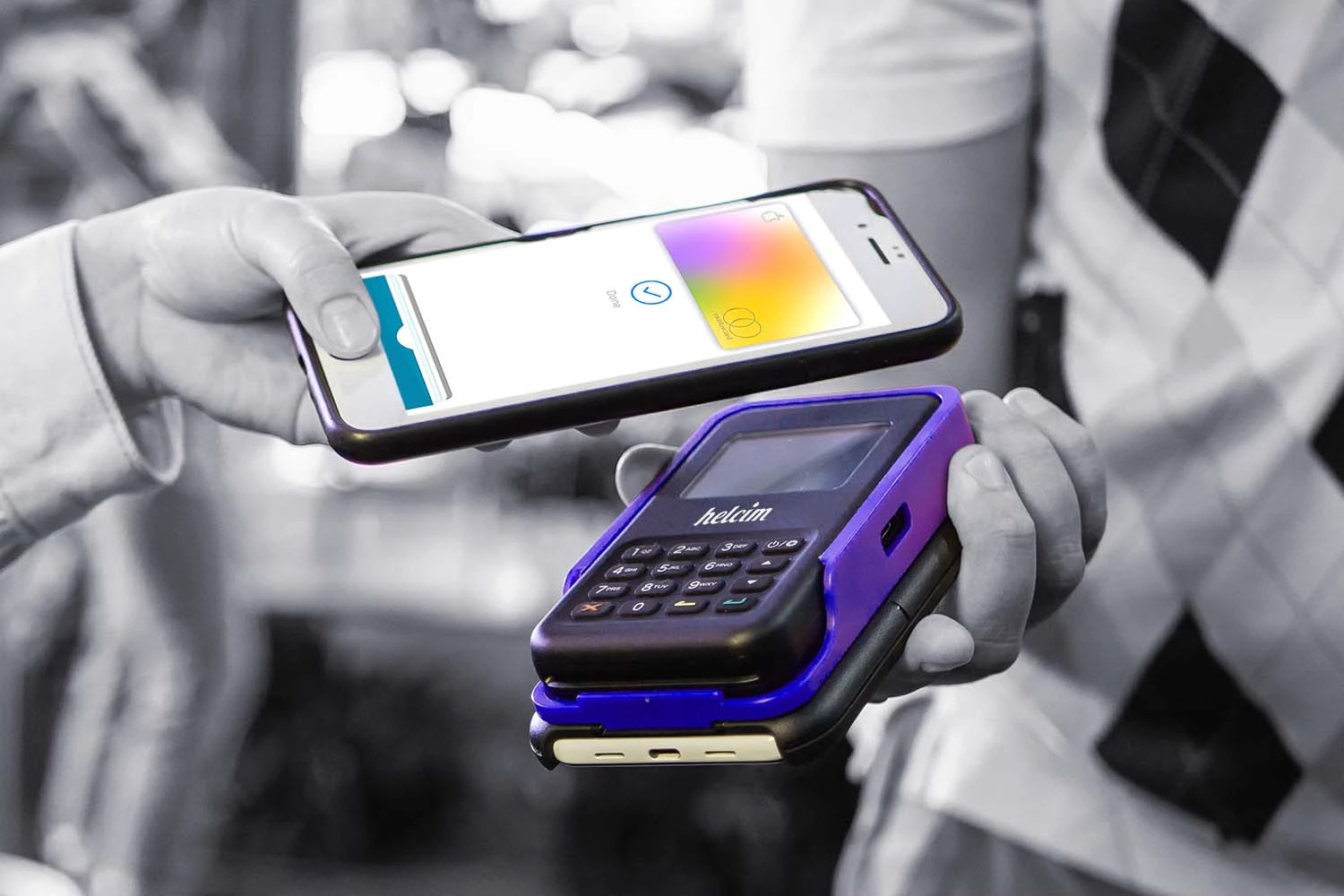
The term "iPhone credit card reader" refers to using your iPhone with a Point-of-Sale app to handle debit and credit card transactions. This can be done with or without hardware.
With payment hardware: You can connect a credit card reader to your iPhone via Wi-Fi or Bluetooth to accept card payments. This setup is ideal for businesses that prefer a simple solution to process transactions in-store or on-the-go.
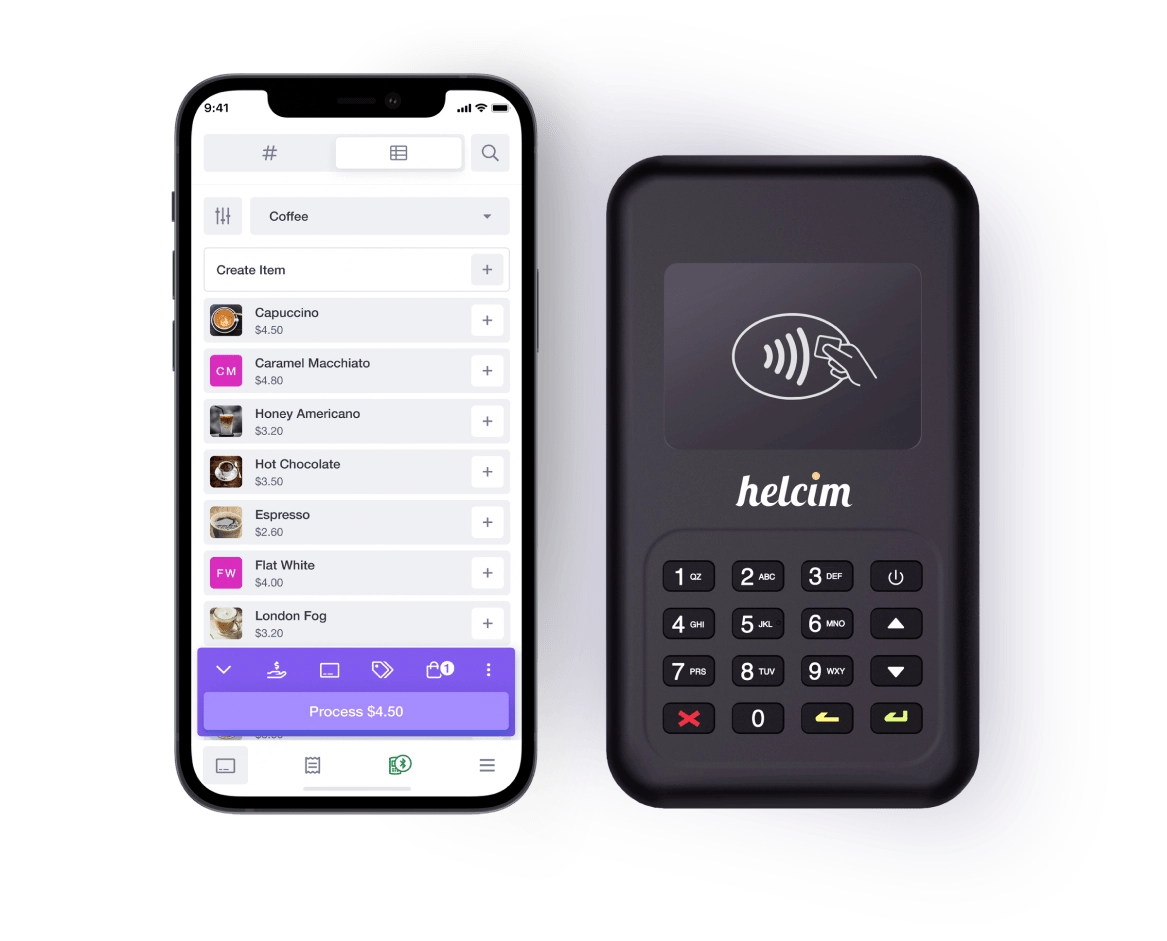
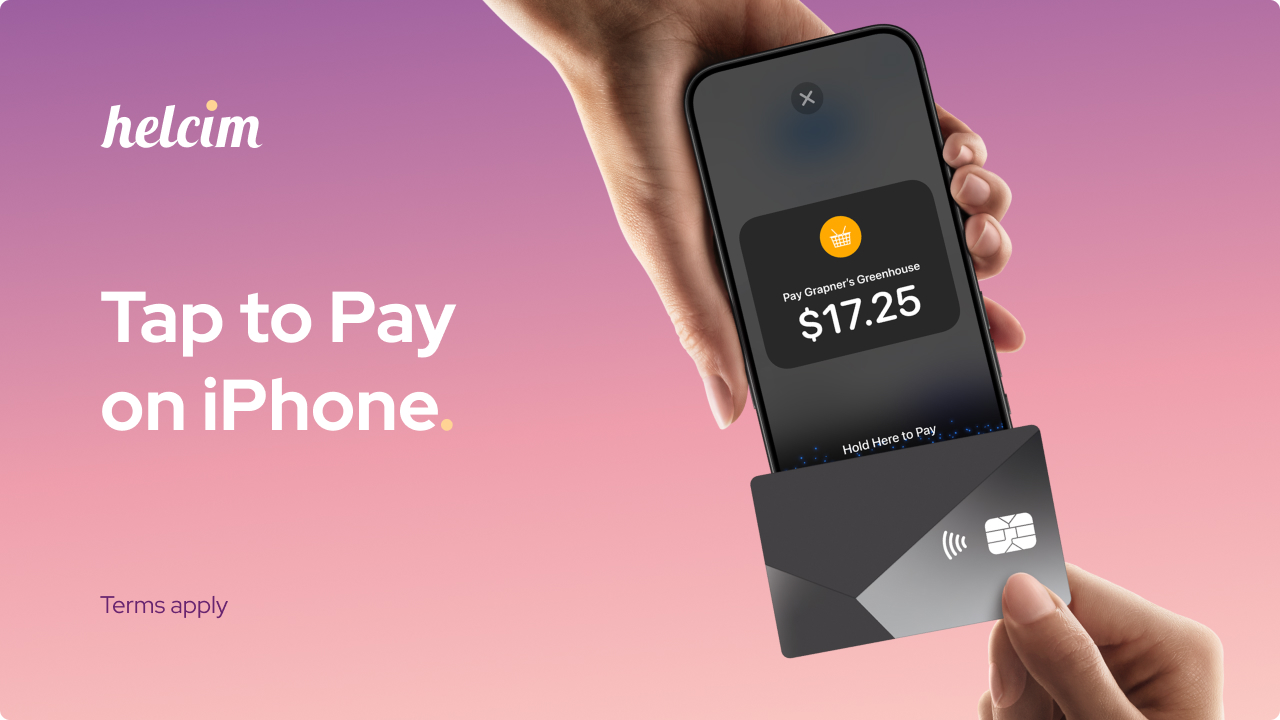
Without payment hardware: If carrying a credit card reader feels cumbersome, you can use Tap to Pay on iPhone to accept credit cards, Apple Pay, and other digital wallets directly from your iPhone. With no upfront costs, Tap to Pay on iPhone is the most affordable and convenient solution for merchants who often process payments on-the-go.
Choosing the right iPhone credit card reader for your business
With an iPhone credit card machine, you can process credit card payments wherever your business takes you. Here are the pros and cons:
Option 1: iPhone with connected credit card reader:
- Pros: Say goodbye to bulky equipment. The minimal setup of just an iPhone and a card reader saves you space and money. Simply connect a card reader to your iPhone via Bluetooth, and you can take payments anywhere.
- Cons: You'll need to purchase a separate credit card reader, which involves an initial investment ranging from $150 to $500.
Option 2: Tap to Pay on iPhone:
- Pros: With Tap to Pay on iPhone, you can accept debit and credit card contactless payments without any additional hardware, saving you space and cost. According to a global consumer study by Mastercard, nearly 80% of respondents revealed they use contactless payments.
- Cons: Tap to Pay on iPhone only accepts contactless payments. If your customers prefer to pay by inserting or swiping their card, you won’t be able to process those payments. You also need to keep your iPhone charged to avoid any interruption.
Which iPhone models work with credit card readers?
The good news is that most iPhones with up-to-date iOS versions are compatible with credit card readers. As long as your iPhone can run the POS app, you can connect it to a card reader. For example, the Helcim POS app requires iOS 16.0 or higher, which includes the iPhone 8 and later models. If you own an older iPhone, such as the iPhone SE (1st generation) or iPhone 6 and below, you won’t be able to run the POS app or pair your card reader with it. It’s also important that your credit card reader has Bluetooth connectivity so it can pair with your iPhone.
Some POS apps, like the Helcim POS app, also include a Tap to Pay on iPhone feature that lets you accept tap payments without an external credit card reader. This feature works on iPhone XS/XR models and newer, since these devices can accept NFC tap payments without additional hardware. So, if you’re using an iPhone XS, XR, or any later model, you can turn your iPhone into a credit card reader, no extra device required.
What payment types can you accept on an iPhone credit card reader?
The types of payments you can accept depend on the credit card reader you pair with your iPhone. Typically, you can accept EMV chip cards, contactless payments (NFC), magstripe card swipes, mobile wallet payments, and manual card entry transactions.
Let’s break down each type of payment:
- EMV chip cards: The customer inserts their credit or debit card’s chip into the reader, enters their PIN, and completes the payment. All modern credit card readers can process EMV chip cards.
- Contactless payments (NFC): Customers can tap a contactless credit or debit card to pay. In fact, 51% of Americans now use contactless payments at checkout. All major card brands like Visa, Mastercard, American Express, and Discover offer contactless cards. These transactions are fast, helping you speed up checkout and serve more customers. If you only use Tap to Pay on iPhone (with no external reader), contactless payments are the only type of in-person payments you can accept because your iPhone doesn’t have a slot for chip or swipe cards.
- Mobile wallet payments: This is also a form of contactless payment, but instead of tapping a physical card, customers use the digital wallets on their phones. With apps like Apple Pay, Google Pay, or Samsung Pay, they can simply tap their phones on your reader to pay. It’s extremely convenient so that Apple Pay alone is used in about 53.7% of in-store mobile wallet transactions.
- Magstripe card swipes: Most modern card readers can still process swiped cards, even though customers are switching to chip and contactless payments. However, if you’re using an older, swipe-only reader, you won’t be able to accept chip or tap payments. Make sure your reader supports all payment types for maximum flexibility.
- Manual card entry (keyed) transactions: Instead of having the customer make the payment directly, you can manually enter their card details in your POS app using a Virtual Terminal. This is typically used for phone orders or remote payments when the card isn’t physically present.
How much do iPhone credit card readers cost?
When using iPhone credit card readers, you usually have to pay for the credit card reader, payment processing fees, monthly POS software/app fees (Helcim doesn’t charge this), and other fees associated with payments. Let’s break down the cost:
1. Credit card reader costs paired with iPhone
One of the great things about using an iPhone for payments is that the POS hardware investment is minimal. Businesses that use an iPhone credit card reader are typically on the go, mobile, or require only a simple setup. In most cases, pairing a credit card reader with your iPhone is all you need to start accepting payments.
Below is the cost comparison of different credit card readers from different merchant service providers.
| Provider | USD pricing | CAD pricing |
|---|---|---|
| Helcim | Helcim Credit Card Reader: $99 | Helcim Credit Card Reader: CA$129 |
| Square | Square Reader: $59 | Square Reader: CA$69 |
| Stripe | Stripe Reader M2: $59 | BBPOS WisePad 3: CA$79 |
| PayPal (Zettle) | PayPal Card Reader: $29 | Unavailable |
| Clover | Clover Go: $199 | Not listed |
| Shopify | Tap & Chip Card Reader: $49 | WisePad 3 Card Reader: CA$69 |
| Authorize.net | Card Reader: $135 | Card Reader: CA$135 |
The credit card reader should support EMV chip, contactless (NFC), and swipe payments. These readers typically cost between USD $29–$150 or CAD $41–$190. More affordable models, such as the Square Reader or Clover Go, usually don’t have built-in number pads, which means you’ll need to hand over your iPhone for customers to enter their PIN or tip, which can be inconvenient.
Most modern credit card readers, like the Helcim Credit Card Reader, also support digital receipts, allowing you to email receipts to customers without needing a physical receipt printer.
2. Payment accessory costs that connect to iPhone credit card readers
The most common payment accessories for iPhone credit card readers are receipt printers and barcode scanners. Receipt printers typically cost USD $295–$305 (or CAD $410–$425), while barcode scanners range from USD $149–$399 (or CAD $210–$560). Before purchasing any accessory, check your merchant service provider’s compatibility list to ensure the accessory you’re buying works with your POS app and credit card reader.
Even though modern credit card readers let you send receipts by email, some customers still prefer paper copies, so a receipt printer is useful in those cases. For businesses that sell products with SKUs, a barcode scanner helps speed up checkout by automatically bringing up the product and price.
3. Payment processing fees for iPhone credit card readers
Every transaction you process with an iPhone credit card reader incurs an in-person payment processing fee ranging from 1.6% to 2.5% of the sale amount. Merchant service providers generally use two common pricing models: flat-rate and interchange-plus.
The interchange-plus pricing model offers the lowest credit card processing fees in the market because it passes through the actual interchange fee set by the card networks, plus a transparent markup.
For example, Helcim charges Interchange + 0.40% + 8¢. On average, Helcim merchants pay 1.83% + 8¢ in the U.S. and 1.67% + 8¢ in Canada. This fee is significantly lower than the typical flat-rate pricing of 2.3% to 2.6%.
Below is a comparison of payment processing fees offered by popular merchant service providers.
| Provider | U.S. processing fees | Canada processing fees |
|---|---|---|
| Helcim | Interchange + 0.40% + 8¢ Average: 1.83% + 8¢ | Interchange + 0.40% + 8¢ Average: 1.67% + 8¢ |
| Square | 2.6% + 15¢ (Square Free) 2.5% + 15¢ (Square Plus) 2.4% + 15¢ (Square Premium) | 2.5% |
| Stripe | 2.7% + 5¢ | 2.7% + 5¢ |
| Clover | 2.5% + 10¢ (Starter plan) 2.6% + 10¢ (Essentials) 2.5% + 10¢ (Services Growth) | Not publicly listed. |
| PayPal | 2.29% + 9¢ | Unavailable |
| Shopify | 2.6% + 10¢ (Basic plan) 2.5% + 10¢ (Grow plan) 2.4% + 10¢ (Advanced plan) | 2.6% + 10¢ (Basic plan) 2.5% + 10¢ (Grow plan) 2.4% + 10¢ (Advanced plan) |
| Authorize.net | 2.9% + 30¢ | 2.9% + 30¢ |
Some merchant service providers like Square, Clover, and Shopify offer different flat-rate processing fees depending on the paid monthly plan you subscribe to.

4. Monthly POS software costs for iPhone credit card readers
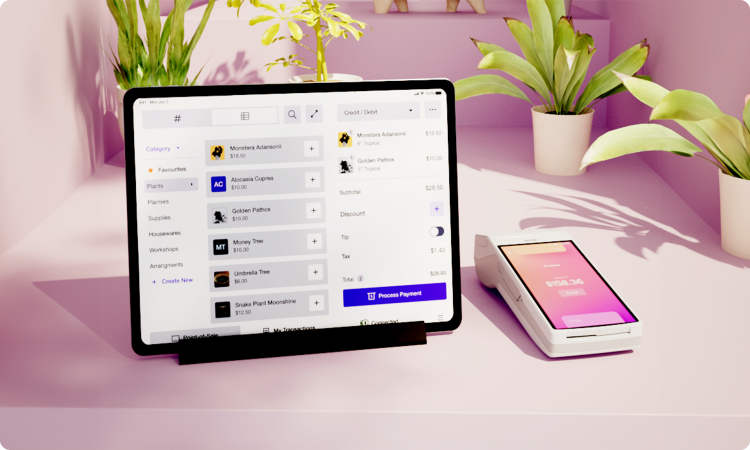
To use an iPhone credit card reader, you’ll need a POS app on your iPhone. The app acts as the bridge between your credit card reader and your phone, allowing you to process and manage payments. Helcim provides its POS software and Helcim mobile app for free, but not every provider does the same.
Below is the detailed comparison of POS software for iPhone credit card readers from different providers:
| Provider | Monthly fee (USD) | Monthly fee (CAD) |
|---|---|---|
| Helcim | $0 | $0 |
| Square | $0 – $149 | $0 – $35+ |
| Stripe | $0 | $0 |
| Clover | $40/mo for 36 months or $749 (Starter) $70/mo for 36 months or $749 + $29.95/mo (Essentials) $125/mo for 36 months or $749 + $84.95/mo (Services Growth) | Not listed |
| PayPal | $0 – $30 | $0 – $35+ |
| Shopify | $39 – $399/mo (Basic – Advanced) $2,300/mo on 3-year term (Plus) $89/mo per location (POS Pro) | $49 – $517/mo (Basic – Advanced) $2,300/mo on 3-year term (Plus) $119/mo per location (POS Pro) |
| Authorize.net | $25 | $25 |
Some merchant service providers charge for advanced features such as detailed reporting, project management, staff management, or website-building tools in their paid plan. If you’re a small business that mainly needs to accept payments on your iPhone or already uses other software for business operations, a free POS app should be more than enough.
Many POS apps also offer integration options so you can connect your POS system to your existing business software. This means there’s often no need to pay for a separate POS subscription if it duplicates tools you already have. And if your merchant service provider doesn't have the integration that you need, you can use the payment API to connect the two systems directly.
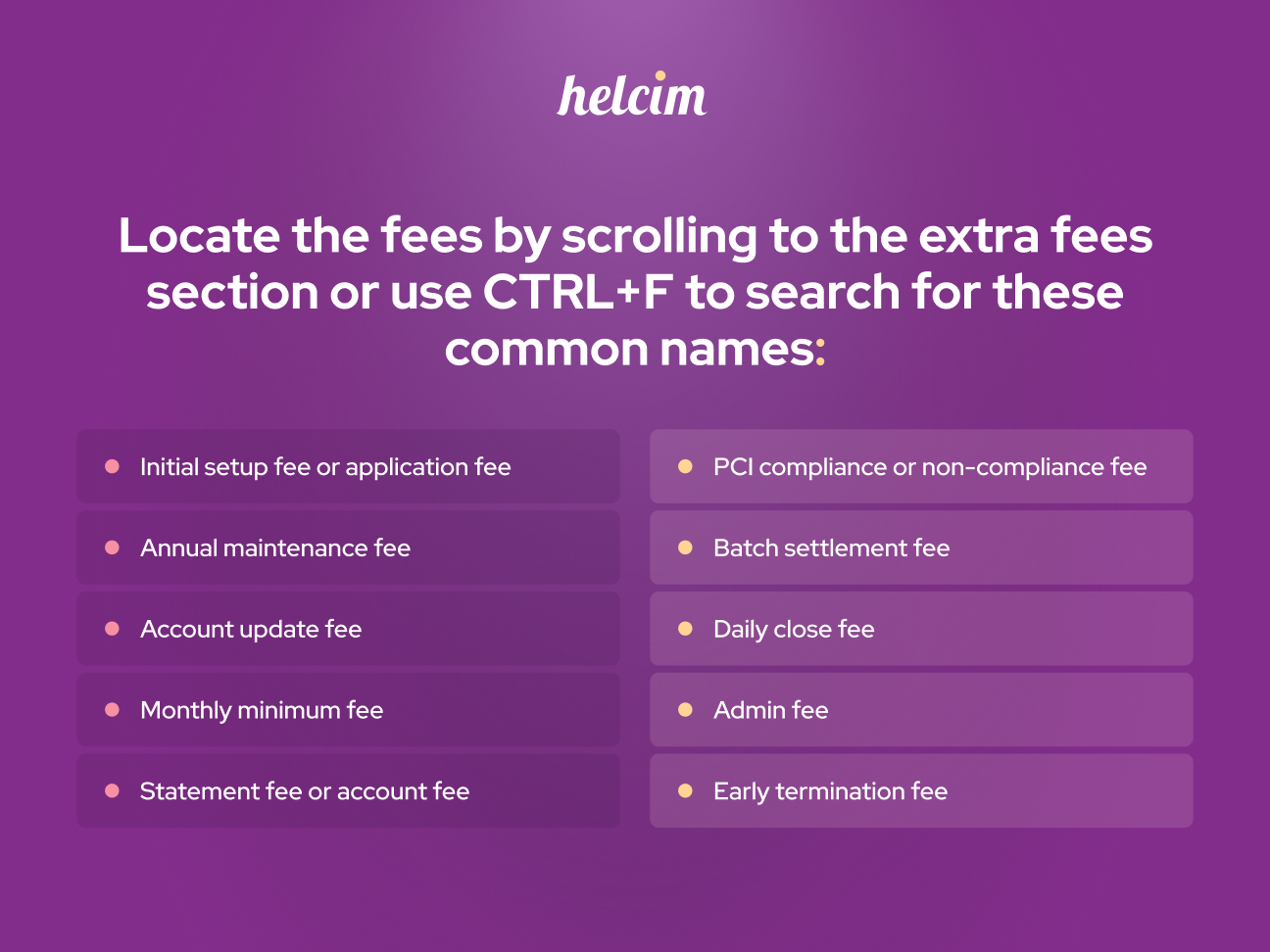
5. Other fees for iPhone credit card readers
Accepting payments using iPhone credit card readers also has other incidental fees, such as using the POS registers or any other methods. Other incidental fees that you need to watch out for are:
Faster fund deposits: It typically takes 1–4 business days for credit card sales and 3–5 business days for ACH/EFT payments to reach your business bank account. If you want faster access to your funds, some providers charge extra. For example, Square charges an additional 1.5% fee for instant deposits. In contrast, Helcim merchants enjoy next-business-day deposits for free.

Chargeback fees: If a customer disputes a charge, most payment processors charge a chargeback fee (commonly $15–$25) to handle it. For example, Helcim charges $15 per chargeback, but refunds the fee if you win the chargeback dispute.
PCI compliance: All payment processors must follow PCI (Payment Card Industry) compliance standards to protect cardholder data. Merchants are often required to complete an annual PCI assessment. Helcim provides this assessment free of charge, while some processors charge hundreds or even thousands of dollars for a compliance assessment or PCI maintenance (something they have to do anyway).
Optional add-on services: Be aware of any optional services that cost extra. For example:
- Stripe charges USD $15 or CAD $21 for access to a SQL environment for custom reporting.
- PayPal adds fees ranging from $0.09 to 1.2% per transaction for using its Online Card Payment Services.
- Moneris (Canada) charges a $5/month gateway fee or $24/year for annual reporting.
Payment hidden fees: Some processors include hidden payment fees in their contracts. For example, Epos Now charges USD $59/month (CAD $64/month) as a terminal inactivity fee if you process less than $2,000, or under 75% of your usual card volume—in a rolling 28-day period. Similarly, PaySimple (U.S.) charges small but unavoidable fees, such as a $0.85 credit card batch closing fee or $0.75 ACH batch closing fee. Always read the fine print before signing a contract to avoid being surprised by these charges.
Cross-border fees: If you process international credit cards, expect currency conversion or cross-border fees. For example, Helcim charges up to 0.68% (Canada) or 1.13% (U.S.), depending on the card brand. Stripe charges 0.8% (Canada) or 1.5% (U.S.) for all international cards.
How to use an iPhone credit card reader
Getting started with an iPhone card reader is usually quick and straightforward.
- Choose the payment service provider
- Install the POS App on your iPhone
- Pair the credit card reader
- Connect all POS accessories
- Configure your business information
- Take a test payment transaction
- Processing your first payment
- Send receipts via email or text
Step 1 - Choose the payment service provider
First, choose the payment service you want to use and create a merchant account. This is typically done online, and you’ll provide information about your business. With Helcim, for example, you can create your free merchant account online (no paperwork or contracts required). Some providers will require a contract, so make sure to read it carefully before signing.
Step 2 - Install the POS App on your iPhone
On your iPhone, download the provider’s POS app from the App Store. For Helcim, it’s the Helcim Point of Sale app. The app is where you will set up your business, add products, connect the credit card reader, and accept payments.
Step 3 - Pair the credit card reader
Now you need to connect your physical credit card reader to your iPhone. Each device might have a slightly different process, but generally, you will need to visit the settings page and turn on the pairing mode. Most merchant service providers will have a tutorial article on how to pair the card reader. For example, Helcim has a full guide of how to set up and connect Helcim Card Reader.
Step 4 - Connect all POS accessories
If you have other POS accessories, you can connect them via the POS app setting section (like what you do to pair the credit card reader).
Step 5 - Configure your business information
Once paired, it’s good to explore the app’s settings to make sure you configure everything like tax, receipt, tip option, product pricing, etc., correctly.
Step 6 - Take a test payment transaction
It’s a good idea to run a small test transaction to familiarize yourself. Helcim actually waives fees on your first $5 of test transactions. Try charging $1 on your own credit card, for instance. This will let you see the flow from start to finish.
Step 7 - Processing your first payment
When you’re ready to charge a customer, enter the transaction amount, select the items being purchased, or use the connected barcode scanner to scan the SKU. The POS app will populate the cart amount for checkout. If everything looks correct, hit charge, and the credit card reader screen will show something like “Insert, Tap, or Swipe Card now.” This is when you hand the card reader to the customer, so they can pay with their cards.
Step 8 - Send receipts via email or text
After the customers make the payments, you can send the receipts via email, text (SMS), or no receipt. If you have a receipt printer connected to your iPhone credit card reader, you might also have a “Print Receipt” option.
How to connect a receipt printer, barcode scanner, or cash drawer to an iPhone credit card reader?
You can often connect accessories like receipt printers or barcode scanners, and cash drawers to your iPhone credit card reader to create a more complete checkout station. But to keep your POS setup mobile and portable, you should connect it using Bluetooth or Wifi. Before ordering any POS accessories, check the accessory and the POS app to make sure that they support Bluetooth or Wi-Fi connection.
To connect the receipt printer or barcode scanner, visit the POS app’s settings and pair the POS accessories to your iPhone, similar to how you’d pair the card reader. Many receipt printers have a port to connect a cash drawer. If you get a compatible cash drawer, it plugs into the printer via a cable. Then, whenever a receipt prints for a cash transaction, the printer sends a signal to pop open the drawer.
Who should use the iPhone credit card reader?
Any business owner with an iPhone can benefit from having an iPhone credit card reader in their toolbelt. However, some businesses will see greater benefits than the others, for example:
Home Services Businesses: Plumbers, HVAC service providers, landscapers, and other professionals are often on the go and need an iPhone Credit Card Reader to accept payments right at the customer’s location.
Health, Beauty, and Wellness: Hair stylists, mobile massage therapists, and similar small businesses can now offer their services and get paid wherever they go.
Automotive: On-site service providers, tow services, and mobile detailers can get paid at job sites.
Pop-up shops: Businesses that are mobile or open shops at trade shows need the flexibility of iPhone credit card reader to easily take payments without being restricted by old, clunky, point-of-sale systems.
Food trucks: Food trucks and street vendors are always on the move and often deal with fast sale-service rates, so an iPhone credit card reader is perfectly suitable for them. Staff can use their iPhone to take orders and process payments while customers are still in line, speeding up service and enhancing customer satisfaction.
How to get started with an iPhone credit card reader?
To get started with an iPhone credit card reader, the first step is to sign up for a Helcim merchant account. Once approved, download the Helcim Point of Sale app. This allows you to enable Tap to Pay on iPhone and connect a Helcim credit card reader to your iPhone.
There are no monthly fees, no contracts, and no hidden charges, so you only pay for what you process. Ready to take payment and manage your business on a single device? Sign up with Helcim to get started.

Save 25% transaction fees with Helcim
With Helcim interchange-plus pricing, thousands of merchants have reduced their transaction fees by ~25%.
Interested in switching to Helcim but feel stuck with your current provider? Helcim's Merchant Buyout Program makes the transition smooth and hassle-free. Here’s what you can expect:
- Personalized support to migrate your data
- We’ll waive up to $500 in processing fees to cover your cancellation costs including early termination fees or equipment leases.
- Enjoy better service, lower fees, and free payment tools.
Break up with your provider and switch to Helcim today!
FAQ
Can an iPhone be used as a credit card reader?
Yes. Download a POS app on your iPhone, then either pair an external Bluetooth card reader or use Tap to Pay on iPhone to accept in-person payments. As long as your iPhone runs a supported iOS version for the POS app, you can use it as a card reader.
Is there an app that turns your phone into a card reader?
Yes. You can download the Helcim POS app to turn your phone into a card reader.
###How do iPhone card readers work? When you pair a card reader with your iPhone, customers tap, insert, or swipe on the reader. The encrypted transaction data goes to the POS app on your iPhone, which submits it to the payment network for authorization and settlement. With Tap to Pay on iPhone, your phone’s NFC securely captures contactless card or wallet payment details and passes them to the POS app. Card data isn’t stored on your phone.
Can you accept payments through your phone?
Yes. You can take in-person card payments via Tap to Pay on iPhone or a paired reader. The POS app also offers other online payment tools like invoicing, virtual terminal, payment links, recurring payments, etc., so that you can take online payments directly through your phone too.
Can you accept payments through your phone without a credit card reader?
Yes. Helcim POS app has a Tap to Pay on iPhone feature that lets you accept contactless cards and mobile wallet payments directly using your phone without a credit card reader required.
How secure are iPhone credit card readers?
Yes, the credit card readers that pair with your iPhone use encryption and tokenization, so raw payment data never touches your phone. The Tap to Pay on iPhone feature uses the phone’s NFC element to capture contactless transaction details. Make sure to choose a PCI-compliant merchant service provider to keep both you and your customers protected.
Do iPhone credit card readers work offline?
Generally, you need an internet connection for the iPhone credit card readers to work. The internet makes sure the payments are processed in real time. Some credit card readers offer an offline mode, but the transaction is still only transmitted to the payment network when the internet is reconnected or turned on. If you use the Tap to Pay on iPhone feature, it will always require an internet connection. Offline transactions can fail later if the bank declines them, so use them with caution. If your wifi is down, the safest plan is to turn on your phone data to keep your business uninterrupted.
Can I print receipts from an iPhone credit card reader?
Yes. Most POS apps support compatible Bluetooth or network (Wi-Fi/Ethernet) receipt printers, and you can also email or text receipts at no cost. Always check your provider’s hardware compatibility list before buying accessories.