



















TL;DR: Key takeaways
- ePHI defined: Electronic Protected Health Information (ePHI) is any digitally stored or transmitted health data that can be linked to a specific individual.
- The communication trap: Standard text messages and emails are unencrypted; sending clinical context or treatment types through them directly violates the HIPAA Security Rule.
- PII vs. ePHI: Personally Identifiable Information (PII) protects identity alone (like a bank transfer), while ePHI explicitly links that identity to healthcare services or clinical treatments.
- The compliance solution: To accept card payments securely, healthcare practices must choose a HIPAA compliant payment provider like Helcim that proactively signs a Business Associate Agreement (BAA) and utilizes bank-grade encryption.
Care vs. compliance: Is your practice accidentally leaking patient ePHI?
Healthcare practices risk accidentally leaking electronic protected health information (ePHI) through digital billing traps such as unencrypted messaging tools, insecure patient communication workflows, and non-compliant payment gateways.
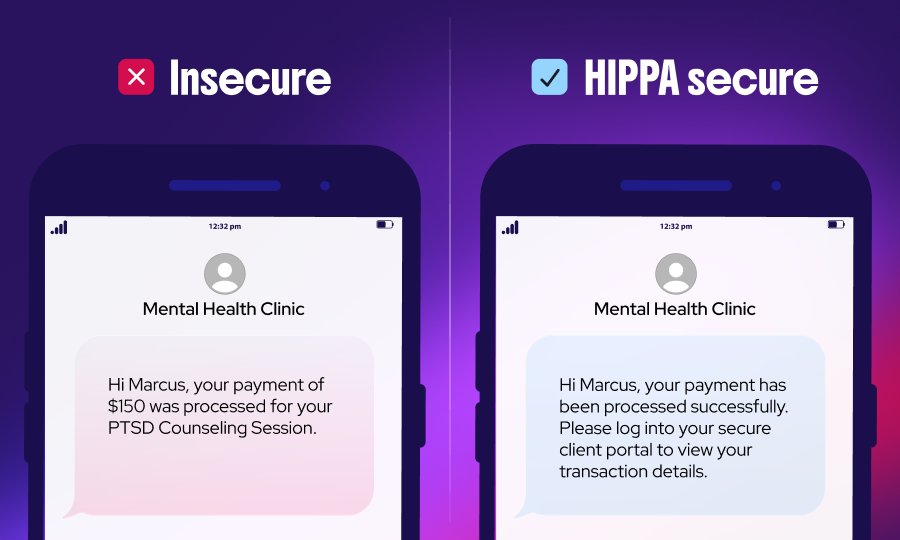
Imagine this: a patient logs onto a clinic website, selects an open slot for an appointment—such as an initial cognitive behavioral therapy (CBT) session or a specialist consultation—and completes their intake payment online using a credit card. A few minutes later, the practice's automated system shoots over a quick text message or email: "Thanks for your payment, Kim! Your appointment for depression and anxiety counseling on Tuesday at 3:00 PM is confirmed."
It seems like standard, friction-free customer service, but behind the scenes, that simple confirmation just triggered a severe regulatory violation. Because that message combined an individual's identity with a specific description of a medical service over an unencrypted, open network, your system just handled ePHI—electronic Protected Health Information without the required federal safeguards. Many healthcare providers, clinic owners, and administrators are unaware that everyday billing and scheduling communications are deeply bound to strict federal privacy laws.
Here is what you need to know about the digital traps hidden in health billing and how to build a highly secure, compliant patient experience, but first, let’s start with the most obvious question.
What is electronic protected health information (ePHI)?
Electronic Protected Health Information (ePHI) is any health data that can be connected directly to a specific person that a healthcare provider creates, receives, maintains, or transmits in a digital format. Under the Health Insurance Portability and Accountability Act (HIPAA), this includes any electronic data that relates to a patient's physical or mental health conditions, clinical provisions, or past, present, and future payments for healthcare services. Learn more about HIPAA compliant credit card processing.
To qualify as ePHI, the data must be stored or sent using digital media. This includes local computer hard drives, cloud storage, emails, text messages, and digital payment portals. If the data contains even one of the 18 HIPAA identifiers (like a name or email address) and connects back to a medical service, it must be fiercely protected.
What are the criteria for payment data to be classified as ePHI?
Payment datais classified as ePHI when it simultaneously contains personally identifiable information (PII) and clear healthcare context. If financial data stands completely alone without any indication of a medical service, it is governed by standard financial regulations rather than health privacy laws.
To determine if your payment processing involves ePHI, look for the overlap of these two elements:
- The identity element: The dataset includes a name, geographic data, birth date, or account numbers.
- The medical context: The transaction records tie that identity to a healthcare provider, clinical treatment, medical or therapy clinic name, or health insurance plan.
What are examples of payment transactions that are ePHI?
Payment transactions become ePHI the moment financial details are bundled with clinical metadata or identifying healthcare markers. Many modern point-of-sale (POS) systems and invoicing softwares accidentally create ePHI by pulling patient records directly into the billing receipt.
Common examples of payment transactions that are ePHI include:
- Patient data & detailed receipts: An itemized digital receipt sent via email that combines a patient's name with specific clinical charges or service descriptions.
- Appointment references: A digital invoice stating a payment is for an upcoming intake session or consultation with a specific physician or specialist.
- Service descriptions: An online payment confirmation screen that displays both the patient's name and a specific diagnostic or treatment code (such as a CPT billing code for a medical evaluation or psychotherapy).
What are examples of payment transactions that are NOT ePHI?
Payment transactions are NOT considered ePHI if they are completely stripped of healthcare context or processed by an independent financial institution. When a transaction contains nothing but raw financial data, it falls outside the jurisdiction of HIPAA.
Examples of non-ePHI financial transactions include:
- Standard Credit Card Swipes: A patient swipes their card at a payment terminal, and the banking network processes only the card number and a dollar amount, without transmitting medical or therapeutic descriptions.
- De-Identified Balances: An invoice that only displays an internal account number and a balance due, without listing the provider’s name, clinic specialty, or medical details.
- General Retail Purchases: Buying standard retail items, such as a self-help book or a mindfulness journal, at a clinic front desk counter.
What is the difference between ePHI and PII in payment transactions?
The fundamental difference between ePHI and PII is that PII identifies who a person is, whereas ePHI connects that identity to their medical history or healthcare usage. Although all ePHI contains elements of PII, not all PII is classified as ePHI. However, this difference carries a distinct financial risk. According to Huntress, healthcare breaches involving ePHI averaged $7.42 million per incident compared to $5.56 million for financial sector breaches involving standard PII.
| Feature | Personally Identifiable Information (PII) | Electronic Protected Health Information (ePHI) |
|---|---|---|
| Core Definition | Any data that can be used to distinguish or trace an individual's identity. | PII that is explicitly linked to healthcare services, conditions, or medical payments in digital form. |
| Governing Laws | Gramm-Leach-Bliley Act (GLBA), PCI-DSS, State-level privacy acts. | HIPAA (Privacy and Security Rules). |
| Transaction Example | A credit card number, billing address, and phone number used to buy a gym membership online. | A credit card number and billing address used to pay for an oncology treatment on a patient portal. |
| Security Focus | Preventing financial fraud and identity theft. | Protecting patient privacy and preventing medical identity theft. |
What are the penalties for mishandling ePHI in payment transactions?
The penalties for mishandling ePHI in payment transactions can range from thousands of dollars for accidental oversights to millions of dollars for systemic negligence. The Office for Civil Rights (OCR) enforces these rules strictly, and fines are structured across a multi-tiered system based on the level of intent.
If your billing system leaks patient data through insecure emails or unencrypted transaction logs, your practice faces severe consequences:
- Tiered Financial Fines: Penalties can range from $137 to over $68,000 per individual violation, capping out at more than $2 million per calendar year for severe, uncorrected neglect.
- Corrective Action Plans (CAPs): The government can force your practice into years of strict, costly oversight and regular federal audits.
- Reputational Damage: By law, breaches affecting more than 500 individuals must be posted on the federal "Wall of Shame," permanently damaging your public credibility.
How a specialized payment provider protects your practice
Specialized healthcare payment providers protect practices from regulatory liabilities by offering built-in HIPAA compliance, signed Business Associate Agreements (BAAs), and end-to-end data encryption at affordable payment processing rates.
While many consumer-grade payment processors ignore health privacy regulations or lock security features behind expensive enterprise tiers, choosing a specialized, transparent platform ensures your data stays safe without draining your revenue. Ultimately, you shouldn't have to choose between affordable credit card processing and massive regulatory liabilities.
Specialized payment providers like Helcim protect patient ePHI through signed Business Associate Agreements, bank-grade data encryption, and HIPAA-compliant systems:
-
Signed Business Associate Agreements (BAAs): A Business Associate Agreement is a legally binding contract that formally ties your payment processor to federal privacy rules. Helcim proudly signs Business Associate Agreements with healthcare and wellness merchants at no extra cost, establishing a shared commitment to data security from day one.
-
Bank-Grade Data Encryption: Cyberattacks account for the vast majority of healthcare data leaks. Helcim safeguards information with AES-256 encryption at rest and TLS 1.2+ encryption in transit, keeping patient records completely scrambled away from prying eyes.
-
HIPAA-Compliant Systems & Multi-Shield Security: Beyond standard PCI-DSS card security, Helcim deploys an extra compliance shield built around the administrative and technical requirements of the HIPAA Security Rule. This includes card tokenization, preventing sensitive medical files from ever touching your local software environment.
FAQ
Is a credit card number on a medical bill considered ePHI?
Yes, a credit card number printed on a medical bill is considered ePHI under HIPAA regulations because it is directly tied to an individual's medical debt and healthcare provider. While the credit card number on its own is just financial data, placing it on a document that details medical services links it permanently to healthcare delivery.
Are all credit card processors automatically HIPAA-compliant and ready for healthcare billing?
No, the vast majority of mainstream credit card processors are not HIPAA-compliant or ready for healthcare billing because they refuse to sign a Business Associate Agreement (BAA). Some popular payment platforms explicitly state in their terms of service that they are not designed to handle protected health information and will not accept the legal liability of a BAA.
To keep your practice safe, you must partner with a healthcare-ready processor like Helcim, which proactively signs BAAs with healthcare clinics at no extra cost, ensuring your financial transaction workflows are completely backed by federal security standards.
Is a transaction ID for a healthcare session considered ePHI?
Yes, a transaction ID can be considered ePHI under HIPAA regulations if it can be reverse-engineered or linked back to a specific patient's medical records. If an auditor or hacker can use that unique ID within your software system to uncover a patient's name or treatment date, that ID must be secured with the same level of encryption as a medical chart.
Can I send an unencrypted email receipt if a patient specifically requests it?
Yes, you can legally send an unencrypted email or text receipt, but only if you first inform the patient of the security risks and document their explicit, written consent. The HIPAA Privacy Rule includes a "Duty to Warn" provision that respects patient preference for convenience.
If a patient prefers to receive standard emails or texts knowing they could be intercepted, your practice must have them sign a clear opt-in form before sending any unencrypted ePHI to protect your clinic from regulatory liability. Despite these risks, 7% of businesses sent patient data through unencrypted emails in 2024.