






















Late arrivals, no-shows and late cancellations or reschedules can have serious consequences for your practice in the short and long term.
After all, a well-functioning practice is one that’s prepared for daily volume and can anticipate revenue — both of which are hard to accomplish if patients don’t arrive on time, or at all.
When a patient no-shows, is late to arrive or cancels or reschedules at the last minute, it can throw a wrench in the whole flow of your operation. Luckily, there are ways to reduce the frequency of missed appointments, as well as recoup some costs when they do happen.
TL;DR
Here's what clinics need to know to reduce patient no-shows, late arrivals and last-minute cancellations and reschedules without damaging patient relationships:
- Define every late arrival, no-show and late reschedule scenario in writing. A written policy sets exact timeframes for late arrivals, no-shows and late cancellations, so patients and staff share the same rules.
- Tell patients about late, no-show or late reschedule fees before they apply. Clinics should share the policy at onboarding, on their website and in every confirmation, which is also what the AMA's ethics guidance asks of physicians.
- Apply the missed appointment policy equally to all patients. Medicare allows missed-appointment fees only when clinics charge every patient the same way, and in the U.S., Medicaid patients can't be charged at all.
- Stack your appointment reminders to reduce late arrivals, no-shows and late reschedules. Phone calls, texts and emails sent before your cancellation window give patients a clear chance to reschedule instead of no-showing.
- Base late and missed appointment fees on reasonable costs. A no-show fee tied to provider time and the unfilled slot is fairer and easier to defend than an arbitrary penalty.
- Use compassion and judgment toward missed appointments. Handle late arrivals privately, follow up on no-shows the same day and waive fees when circumstances are truly beyond a patient's control.
- Collect missed appointment fees with a card on file. Storing a patient's card with signed consent lets clinics collect missed-appointment fees the same day without chasing payment.
Picture this. You own a busy dental clinic, and most of the time your schedule runs like clockwork. Patients get seen at their booked time, procedures finish on time, and your daily revenue matches your forecast.
Then, one day, a 10 a.m. patient doesn't show. The 11 a.m. patient arrives 25 minutes late and your 2 p.m. patient calls at 1:15 to reschedule. By the end of the day, your hygienist has sat idle for two hours, three on-time patients have waited in the lobby, and one of them is drafting a Google review.
You want to nip this in the bud before it becomes a pattern.
Patient no-shows, late arrivals and last-minute reschedules drain clinic revenue, disrupt care and wear down the experience for every patient who shows up on time. The numbers back this up. A study of ten U.S. Veterans Affairs clinics found a mean no-show rate of 18.8%, and an average cost of $196 per no-show patient in 2008. Adjust that figure for today's costs, and every empty appointment time hurts even more.
The good news is that clinics can control many factors that improve attendance, as well as help recoup costs from missed appointments. A clear written policy, consistent communication and a fair way to collect fees will protect your schedule without putting your front desk in an uncomfortable position.
What are appointment reschedules, late arrivals, and no-shows?
Appointment late arrivals, no-shows and late cancellations or reschedules are the three most common ways patients disrupt a clinic's schedule, and each one needs its own definition in your policy.
Here are the four terms every clinic should define, with the timeframes many practices use as a starting point:
- Late arrival: A patient who arrives after the grace period your clinic sets, often 15 minutes past the scheduled start time.
- No-show: A patient who fails to attend their scheduled appointment without giving any notice. No-shows hurt the most because your team has no chance to fill the slot.
- Late cancellation or late reschedule: A patient who cancels or reschedules less than 48 hours before the appointment. A 48-hour window gives your team enough time to call a waitlisted patient and fill the appointment.
- Reschedule: A patient who moves their appointment to a new date or time. A reschedule made with plenty of notice is healthy.
How to create policies for no-shows, late arrivals and late cancellations or reschedules
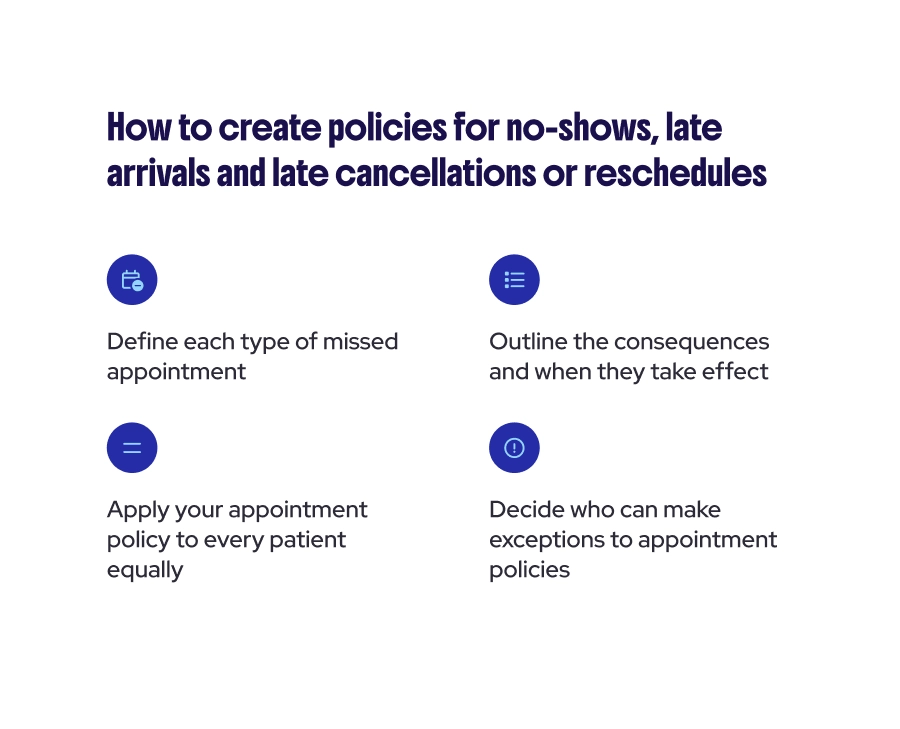
To create policies for no-shows, late arrivals, late cancellations or rescheduled, you need to take the following steps: Define each type of missed appointment, outline the consequences and when they’re applied, apply the policy to each patient equality and decide who can make exceptions.
Define each type of missed appointment so everyone is on the same page
Be clear about how you define each category, and don't assume a patient knows. A patient may consider 30 minutes late, while your practice counts anything more than 15 minutes past the start time as a late arrival. Your policy should spell out your exact timeframes for a late arrival, a no-show and a late cancellation or late reschedule, so nobody has to guess.
Outline the consequences and when they take effect
Your policy should explain what a patient can expect if they arrive late, don't show up, or cancel or reschedule late. Will you charge a fee, require phone confirmation for future appointments, or both? Be just as clear about when these consequences apply. Some practices use a three-strikes policy, while others apply their policy on the first offense.
While 42% of medical practices state that they charge a fee for missed appointments, not every penalty has to be a fee. For example, after a missed appointment, you may require that the patient verbally confirm their next appointment with clinic staff by phone.
If your policy includes fees, patients need to know about them ahead of time. The American Medical Association's Code of Medical Ethics calls on physicians to clearly notify patients in advance of any fees the practice charges, including fees for missed appointments or appointments not cancelled in keeping with the practice's published policy. The guidance is written for physicians, but it's a good standard for any medical or paramedical practice to follow.
Apply your appointment policy to every patient equally
A fair policy applies to every patient in the same way, and for U.S. practices, it's also a compliance issue. Centers for Medicare and Medicaid Services (CMS) policy states that if a practice charges Medicare patients for late or missed appointments, no-shows and late reschedules/cancellations, it must charge everyone else the same way too. Plus, Medicare won't pay these charges and patients must pay out of pocket.
Medicaid is different. CMS has consistently advised that Medicaid members shouldn't be charged for missed or canceled appointments, as Colorado's Medicaid agency explains. So, check your state's rules before you publish a fee.
Decide who can make exceptions to appointment policies
Your policy should name who has the authority to waive a fee or bend the rules. Generally, it shouldn’t always fall on you as the head of the business to decide, nor should it be up to every staff member’s discretion (this is a quick way for exceptions to get applied inequitably). Choose a small number of people, or a certain role (e.g. Managers) to smooth out the process and contain the exceptions — and then give clear, written guidance on what types of scenarios warrant exceptions (e.g. sudden illness).
How should you communicate your appointment policies?
To communicate appointment policies effectively, clinics should have patients acknowledge them at intake, make their policies readily available online, and include them in appointment confirmations and reminders. A policy is only as good as it is understood and acknowledged, and each of these touchpoints helps patients know what's expected before it ever applies to them.
Have patients acknowledge the policy during intake
When you bring on a new patient is one of the best times to introduce your policy. It gives them time to read, understand and ask questions before you ask them to sign off that they understand what's expected.
This is also a great opportunity to show how these policies put the patient experience first. You can explain how late arrivals, no-shows and late reschedules or cancellations affect other patients, and how your practice prides itself on serving every patient in a timely way.
Make the appointment policy available on your website
It's good to assume the best in people. Most of your patients want to understand your policies on late arrivals, no-shows and cancellations so they can follow them. Making your policy available on your website, through a link in your header or footer or in an FAQ section, ensures people can find the information when they need it.
Include the policy in your appointment confirmations
Whenever you book a new appointment, let patients know what they need to do if they have to reschedule. Having options pays off, as studies show that close to 70 percent of patients are more likely to show up for an appointment when they have access to online rescheduling. Whether you include a QR code to a rescheduling calendar or a simple link to your policy, every little bit of communication helps set both parties up for success.
Send reminders and appointment confirmations before the 48 hour cancellation and reschedule window
Reminders can greatly reduce the number of issues that fall within your cancellation and rescheduling window. A systematic review of 29 studies found that reminders cut non-attendance by 29% of the baseline rate when they were automated and by 39% when done by phone call.
These are the touchpoints we recommend:
- Confirm appointments 5 to 7 days in advance. Confirm the appointment by phone, email or text message. This could be automated to reduce admin work, or done manually. A phone call made by a real staff member also gives your clinic the chance to talk to the patient about the aim of the appointment, so patients are reminded why it's important to attend.
- Stack your appointment reminders. Even after an appointment is confirmed, it’s worth it to send reminders. Send a text message and email 72 hours before the appointment, and a text message 48 hours before. These reminders help patients remember their commitment and give them one last chance to cancel or reschedule before it becomes a late cancellation or no-show. A meta-analysis of digital notifications found that sending two or more reminders improved attendance by up to 19% compared with sending just one.

How should clinics handle no-shows, late arrivals and late cancellations?
Clinics should handle no-shows, late arrivals and late cancellations with a mix of clear policy and empathy.
These events don't just affect patients' lives. They can be highly disruptive to the flow of your practice and to the experience of other patients, who may have arrived on time but now have to wait longer because someone else's appointment ran over.
As compassionate care providers, you know as well as anyone that sometimes life happens. A patient forgets an appointment when their child's school calls to report an illness. A traffic accident on the way to the clinic makes a patient late. A last-minute work emergency means a patient has to give less than 48 hours' notice on a reschedule.
While policies are important to protect your practice and the patient experience, so is demonstrating compassion and judgment when things go "wrong." Forgiving a late arrival or waiving a fee when circumstances are beyond a patient's control can go a long way toward building a great patient experience and a strong reputation for your practice. Meanwhile, having policies in place helps ensure you're not taken advantage of, either.
How should clinics handle late arrivals?
Late arrivals are a unique scenario compared with no-shows and late cancellations, because the patient has actually made the effort to attend their appointment and is now in your clinic.
If honoring the appointment truly isn't possible without disrupting the rest of the practice, you'll need to tell the patient they can't be seen today, explain why and, depending on the situation, offer them a rescheduled appointment.
Sharing all of these details in a busy clinic, with lots of other people around, can be distressing or even embarrassing for the patient. Someone who has shown up despite real barriers may feel humiliated if they're turned away loudly in the waiting room, so it helps to talk with them somewhere more private if you can.
Make sure your staff know to approach the situation without anger or shaming. The goal is to preserve the patient relationship in a tough moment where you have to ask them to come back another day.
That being said, there are some situations where not seeing the patient that day could cause real medical distress or keep them from necessary care. In these cases, use your discretion and medical knowledge to decide what to do next. Sometimes one day of clinical disruption is worth the added stress, especially if a patient's health is on the line.
How should clinics handle no-shows?
To handle no-shows effectively, clinics should follow-up with the patient the same day. In fact, acting fast is one way to preserve the patient relationship. Studies show that patients who miss a single visit are 70 percent more likely not to return in the next 18 months. A quick call or text letting the patient know you missed them, and offering to rebook, keeps them connected to your practice and gives them a chance to explain what happened. From there, apply your policy as written and note the no-show in their file so your team can spot patterns over time.
How should clinics handle late cancellations and reschedules?
Handling late cancellations and reschedules is most effectively done by keeping a waitlist list that can be filled automatically.
Afterall, while a late cancellation leaves you with an empty slot, it also gives you a small window to fill it. Keeping a waitlist of patients who'd happily take an earlier appointment can turn a last-minute cancellation into a full schedule again.
In fact, waitlist management can be automated to fill these appointment slots even more effectively. Some statistics show that clinics can expect 60-85 percent of canceled appointments filled when using automated systems, compared to 15-30% with manual processes. Plus, if you fill the slot, you may decide the fee isn't necessary at all.
How much should healthcare clinics set for a no-show fee and last-minute reschedule?
The amount clinics charge for no-show or last-minute reschedule varies from nominal amounts, like $30, all the way up to the full appointment fee. Healthcare clinics should set no-show and late cancellation fees based on the reasonable cost of a missed appointment to the practice.
Helcim's guide to appointment deposits puts primary care fees in the $25 to $50 range, with higher fees in surgical settings, where operating room time and staff scheduling cost more.
Meanwhile, the AMA's ethics guidance offers a helpful principle here: fees for missed appointments should be based on reasonable costs to the practice.
Healthcare clinics setting a no-show or last-minute reschedule fee should evaluate four key factors: appointment length, notice period, patient financial impact, and payer regulations.
- The length and value of the appointment. An empty hour-long procedure costs your practice far more than a missed 15-minute check-in, so a higher fee for longer appointments makes sense.
- How much notice you received. A no-show gives your team no chance to fill the slot, so some clinics charge more for a no-show than for a late cancellation.
- Who your patients are. Regardless of how much you decide to charge, remember that late and no-show fees usually aren't covered by insurance. What you're asking of your patient is likely to be an out-of-pocket expense, and a fee that seems small to one patient might keep another from coming back.
- Your payer rules. Medicaid patients can't be charged for missed appointments, and some private payers have their own rules, so check before you set a fee.
Whatever amount you choose, include the exact number in your written policy so there are no surprises.

How can healthcare clinics collect no-show and last-minute reschedule fees?
Healthcare clinics can collect no-show and last-minute reschedule fees through four main methods: cards on file, upfront deposits, emailed or texted invoices, and balances collected at the next visit.
Collecting these fees can be tricky, because the best time to collect patient payments is when the patient is in your building, and that's not the case here. According to Rivet Health, clinics can only expect to collect 50–70% of patient balances after the visit. That being said, clinics can use these following Helcim payment tools to collect no-show and last-minute reschedule fees:
- Card on file: Clinics can collect signed consent and store a patient's card on file at intake using Helcim Card Vault. If the patient misses their appointment, your front desk can charge the missed-appointment fee through Helcim's Virtual Terminal the same day, without an awkward follow-up call.
- Bank account on file: Patients can also save their bank account details instead of a credit card. Helcim stores bank details in the same customer profile and processes automated clearing house (ACH) and electronic fund transfer (EFT) payments at a lower cost than credit cards, at 0.5% + 25¢ with a $6 cap. Bank accounts also don't expire the way cards do, so the payment details you have on file stay current.
- Deposits: For longer or higher-value appointments, clinics can use Helcim to send payment links by email or text so patients can pay appointment deposits up front. The deposit goes toward treatment if the patient shows up, and covers the fee if they don't.
- Invoices or payment links: If you don't have a card on file, you can send an invoice or payment request by email or text. With Helcim Invoicing, a patient can pay from their phone in a few seconds.
- Collecting fees at the next visit: You can add the fee to the patient's balance and collect it at their next appointment using a Helcim card reader at the front desk. This keeps the conversation face to face, but it's the least reliable option, since some patients who miss appointments don't come back. If a balance lingers, these tips on how to collect past-due balances can help.
Use Helcim’s Card Vault to securely store cards on file
Of the options above, a card on file is the most reliable way to collect a missed-appointment fee, because it doesn't depend on the patient doing anything after they've missed their slot. It's also the most flexible. Once a patient's card or bank account is saved, your team can use it for no-show fees, deposits, invoices or payment plans.
Card-on-file payments come with responsibility, so make sure patients know what you may charge and when, and keep their consent on file.
Helcim Card Vault stores patient card details securely by replacing the card number with a token, so your team can reuse a saved card for invoices, Virtual Terminal payments or recurring payments, with no monthly fee to use it. If your clinic runs on practice management software like Jane App or Noterro, Helcim's Payment Extension lets your front desk take payments without leaving that platform.
Transparency goes both ways. Your patients deserve to know exactly what they'll pay and why, and you deserve payment processing for your healthcare practice that's just as upfront with you.
FAQ
How do you communicate appointment policies to patients effectively?**
The most effective way to communicate your appointment policy is early and often, in plain language, before any fee applies. Frame the policy around the patient experience, since it exists to make sure every patient is seen on time. Share it during onboarding, on your website and in every appointment confirmation. Use specific numbers, like "15 minutes" and "$50," so there's no room for confusion. When patients understand why a policy exists, they're more likely to follow it.
How should healthcare practices handle frequent reschedules?**
If a patient reschedules often, start with a private conversation before applying stricter rules. Frequent reschedules can point to real barriers, like unreliable transportation, shift work or caring for family members. Ask what's getting in the way, and see whether early-morning appointments, telehealth or shorter visits would help. If the pattern continues, your policy can require a deposit or prepayment for future bookings. Keep a record of each reschedule so your team can apply the policy consistently.
What is a patient appointment grace period?**
A patient appointment grace period is the window after the scheduled start time when your clinic still considers the patient on time. It gives patients a small buffer for parking, traffic or checking in, without triggering your late arrival policy. The right length depends on your appointments. For a 30-minute visit, a 10- to 15-minute grace period can still leave enough time for meaningful care. Include your grace period in your written policy so patients and staff are working from the same definition.