






















Learn the difference between copays, deductibles and coinsurance, how Health Savings Account (HSAs) and Flexible Spending Accounts (FSAs) can be used towards these expenses and discover the best way to collect these types of payments.
TL;DR
Here's what this article covers, at a glance:
- Copay, deductible, and coinsurance are three different cost-sharing mechanisms, and most patients are on the hook for some mix of all three depending on the service.
- HSAs and FSAs can often be used to collect copays and deductibles.
- HSAs can explicitly be used towards copays, deductibles, and coinsurance, as long as funds are available.
- General-purpose FSAs can be used towards these expenses too, but a limited-purpose FSA usually only covers dental and vision, so it's worth checking which type a patient has.
- It's best to verify insurance and communicate expected amounts owing a day or more in advance of the patient's appointment.
- The best time to collect copays, deductibles and coinsurance is before the patient leaves your clinic or practice.
- Payment methods for collecting copays, deductibles and coinsurance range from HSA and FSA cards, to credit and debit, all the way to invoicing after the appointment.
What is the difference between a copay, a deductible, and coinsurance?
The difference between a copay, deductible and coinsurance is confusing to a lot of people. According to Forbes Advisor survey, 77% of insured Americans are confused by basic health insurance terms. In short: a deductible is what you pay before insurance starts sharing costs, a copay is a fixed fee per service, and coinsurance is a percentage split of the bill. It helps to go through them one-by-one, with examples in a clinical context.
What is a deductible?
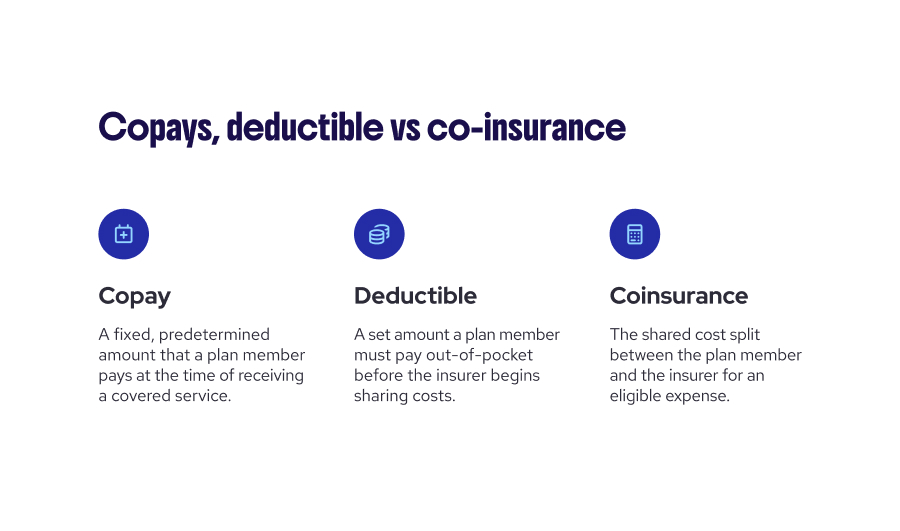
A deductible is the amount an insurance plan member must pay before the insurer begins sharing costs.
Deductible example: Debbie’s insurance covers physiotherapy, but she has a $500 deductible to meet first. At check-in, the clinic’s front desk reminds her of this deductible, so she isn’t caught off guard. Until Debbie’s paid $500 out of pocket for covered visits, her insurance won’t contribute anything. After that, her insurance begins to share the cost for future treatments.
What is copay?
Copay is a fixed, predetermined cost that the plan member pays for a covered service.
Copay example: Jerome sees a solo psychotherapist every week. The cost of his hour-long appointment is $150. His insurance sets a flat $30 copay per session, so any time he completes a session his copay doesn’t change. It’s $30 every time and under Jerome’s plan, the remainder of the visit cost is covered by insurance.
What is coinsurance?
Coinsurance is when a plan member and the insurer share the cost of an eligible expense, splitting it by a percentage. When a patient's plan sets a maximum allowable amount for a service, the coinsurance split is applied to that maximum. If the provider is out of network, the patient may also owe the remainder out of pocket.
Coinsurance example without a plan maximum: Alex’s plan requires the patient to cover 20 percent of eligible costs. After a $300 session with a psychologist, the bill splits between the insurer (80 percent, or $240) and Alex (20 percent, or $60).
Coinsurance example with plan maximum: Skylar's plan has an 80/20 coinsurance split and caps the allowable amount for chiropractic care at $500 per service. She sees an out-of-network chiropractor for $600 in care. Her insurer covers 80 percent of the $500 maximum ($400). Skylar owes the 20 percent on that maximum ($100), plus the extra $100 between the full bill and her plan's cap.
Understanding how coinsurance, copay and deductibles work together
It’s important to know that whether a patient needs to pay coinsurance, a copay or a deductible varies on a plan-by-plan basis. Some plans may require all three, while others require two together (e.g. a copay and then coinsurance), one alone (e.g. a deductible), or none.
For example, a patient’s coinsurance may not kick in until after a deductible is met. And then once coinsurance is actively in use, there may also be a copay required as well.
This can also vary from service to service. Some types of care may have no deductible and only require a copay, while other types of service need a deductible to be met before the insurer contributes.
This is why it’s so important to run a client’s insurance information a day (or ideally, more) before they are due to attend an appointment. No one, from the front desk to the patient, loves billing surprises.
How do Health Savings Account and Flexible Spending Account payments work for copays, deductibles and coinsurance?
As a healthcare clinic you may be tempted to use Health Savings Accounts (HSAs) or Flexible Spending Accounts (FSAs) to help cover copays, deductibles and coinsurance, and for the most part, you’d be right to do so.
However, before you reach for the card, it can help to know what these types of accounts entail, as well as what to consider about using them for these types of payments.
What are HSA and FSAs?
HSAs and FSAs let patients set aside pre-tax dollars for qualified medical expenses, usually through a Visa or Mastercard card they can use at checkout.
HSAs belong to the patient and roll over year-to-year, while FSAs are employer-sponsored and typically follow a use-it-or-lose-it rule.
For your practice, these cards process like any other card payment once your merchant category code (MCC) is set up correctly, and you can learn more about accepting HSA and FSA cards here.
Can you use a HSA or FSA to pay for copays, deductibles and coinsurance?
According to healthcare.gov, Health Savings Accounts (HSAs) and Flexible Spending Accounts (FSAs) can be used to pay for these expenses. Using these accounts to collect payments is easy, as it’s usually possible for a patient to pay with an HSA/FSA-linked debit card at time of purchase, or pay out of pocket and submit for reimbursement later (keeping receipts for tax purposes).
However, there are some things to keep in mind before you charge one of these accounts. For HSAs, it comes down to available balance, and for FSAs, it comes down to which type the patient has.
Using HSAs to cover copays, deductibles and coinsurance
While you are technically able to bill HSAs to cover copays, deductibles and coinsurance, whether or not there’ll be enough money in the account to cover these fees depends on the balance. The funds in a HSA are limited by how much a member has contributed. So, while it’s possible to save an HSA card on file in your clinic, the payment should always be patient initiated. Learn more about how healthcare clinics should store patients’ credit cards on file.
Also, you can check in with the IRS for the most up-to-date information on what expenses are eligible to be covered by a HSA.
Using FSAs to cover copays, deductibles and coinsurance
By law, FSAs are backed by their full annual amount from day one. For 2026, the IRS reported that this amount was increased to $3,400. So, while funding may not be an issue, the type of FSA may be.
General-purpose FSAs are capable of covering copays, deductibles and coinsurance, but limited-purpose FSAs usually restrict reimbursement to dental and vision expenses only. Definitely check which one a patient has before assuming you can use the FSA.
When is the best time to collect a patient’s copay, deductible, and coinsurance?
The best time to collect a patient’s copay, deductible and coinsurance is at check-in or check-out.
Once a patient walks out the door, collecting gets more difficult, so the sooner you ask, the more likely you are to get paid.
Whether you collect at check-in or check-out is a real choice: Some practices prefer the certainty of collecting before the visit, while others prefer to wait until the final cost is confirmed after the appointment. Either works. What doesn't work is treating collection as an afterthought.
Regardless of which point you choose, verifying your patient’s insurance coverage 24-48 hours before the appointment makes it easier to prepare your bill, and your patient. You’ll know what’s covered and what isn’t, and can set expectations with the patient before they arrive.
How should healthcare practices collect copays, deductibles, and coinsurance?
Healthcare practices can collect copays, deductibles and coinsurance from patients using payment terminals, cards on file, virtual terminals, payment links, invoicing and recurring billing, with each payment method suited to a different point in the visit or billing cycle:
1. Collecting at check-in or check-out with a payment terminal
Payment terminals collect payment while the patient is still in front of you. Collecting in person settles the balance before they walk out, when you're most likely to get paid. For example, a patient with a $30 copay taps their HSA card at the front desk and the visit is closed out in seconds.
For the clinic, setup means buying a card reader once, and each transaction is charged at the lower in-person rate. Helcim's point-of-sale hardware is a one-time purchase with no lease, no monthly fee and no contract, so your front desk equipment never turns into a bill you can't get out of.

2. Charging a card on file once the claim is processed
Cards on file let you charge a patient's stored card once the final amount is confirmed. This matters for coinsurance, where the patient's share often isn't known until the insurer processes the claim. For example, a physiotherapy clinic charges a patient's saved card for their 20 percent share of the bill at a later date, using the consent they collected at intake.
For the clinic, the setup is lighter than it sounds. Consent can be as simple as a checkbox or e-signature on your intake forms, and Helcim's Card Vault handles secure storage by replacing the card number with a token. That means no hardware, no photocopied cards and no card numbers on sticky notes.

3. Taking payments over the phone with a virtual terminal
Virtual terminals let your staff enter a card payment from a computer when the card isn't physically present. They're useful when a patient would rather settle a balance over the phone. For example, a patient who receives a statement for their deductible calls the front desk, and the payment is processed while they're still on the line.
For the clinic, there's little to set up, but keyed-in payments count as card-not-present and usually cost more per transaction than an in-person tap. Helcim's virtual terminal comes included with your account, and the keyed-in rate is published upfront, so you know exactly what a phone payment costs before you take one.

4. Sending payment links for balances between visits
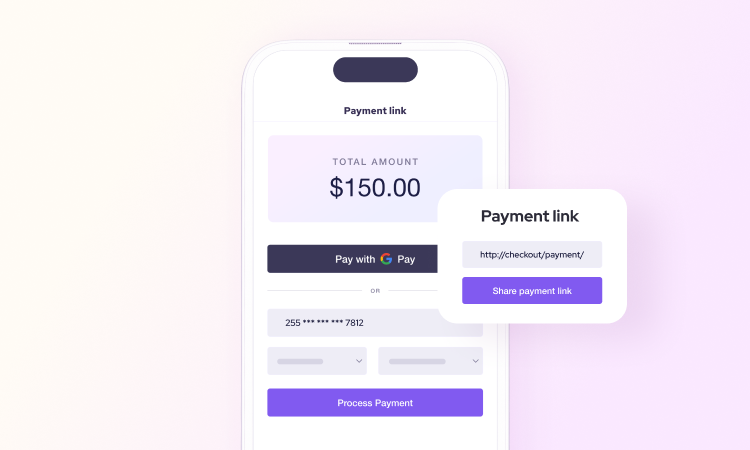
Payment links send patients a secure page where they can pay from their phone or computer. They work well for balances that come up between visits, since the patient can pay in a few taps without logging in to anything. For example, a clinic texts a patient a link for their $45 copay right after a telehealth session.
For the clinic, links need no hardware and are charged at card-not-present rates, like other online payments.Your front desk can create a link in a few clicks and send it the moment a balance is confirmed. With Helcim's payment links, that rate is published transparently.
5. Invoicing patients after the appointment
Invoicing gives patients an itemized bill they can pay online after they've left the clinic. It can work as a primary means of billing or as a fallback when a balance wasn't collected at checkout, and it gives both sides a clear record of what's owed. For example, a patient whose deductible wasn't confirmed on the day of their appointment gets an invoice by email and pays it that evening. Learn how to create HIPAA compliant invoices.
With invoices, you only pay processing fees once the patient pays, but you're relying on the patient to act, so balances can sit longer. Helcim's invoicing is built into your account at no added software cost, and it's designed with HIPAA-compliant invoicing in mind.

6. Setting up recurring billing for payment plans and ongoing care
Recurring billing charges a patient's stored card automatically on a set schedule and is best suited for either splitting a larger balance into a payment plan or collecting a predictable copay for ongoing treatment. For example, a patient facing a $1,200 deductible early in the plan year agrees to four monthly payments of $300. Meanwhile, another patient with a flat $30 copay for weekly therapy, is charged automatically each week.
Recurring billing setup requires a card on file, the patient's consent and an agreed schedule. Helcim's recurring payments add 0.4% per transaction, so you can factor it into a payment plan before offering one. Once the plan is set, the charges run on the card you already have stored.
What should clinics look for when collecting copays, deductibles and coinsurance?
Clinics should look for payment methods that keep them compliant with HIPAA and PCI DSS and make paying easy for patients.
On the one hand, you need to make sure that your billing practices are not breaking any laws. This means ensuring your invoices are HIPAA compliant as well as that your payment practices protect electronic Protected Health Information (ePHI) under HIPAA. Plus, any card or payment data you handle needs to meet PCI DSS requirements. Both matter if you're collecting card payments.
And on the other hand, you need to know that there are pros and cons to offering different payment solutions.
As a general rule, the best payment processing solutions reduce friction for you and your patients alike. They offer the ability to collect payments in person as well as with a card on file. Plus, they allow you to provide follow-up reminders for patients to pay at a later time too.
In contrast, the worst ones inject unnecessary hassle into the process — a redundant login, a separate system, another month of outstanding A/R. Having one good payment portal that’s integrated into how you already work will always beat out three overlapping ones that the patient has to figure out on their own.
Are there fees associated with charging credit cards for deductibles, copays and coinsurance?
Yes, clinics are charged the fees from 1.7% to 3% when processing credit card payments for deductibles, copays, and coinsurance.
How much your clinic is charged is completely up to the payment processor you use.
A lot of clinics are still processing cards without knowing what it's actually costing them.
And that's by design. Many payment processors hide their rates behind a sales call, then stack on more fees down the line, like equipment leases that outlast the contract and early termination penalties that appear when a business tries to leave.
Interchange-plus pricing, like Helcim’s, publishes the actual cost of processing and adds a transparent markup on top of it, so you’re not stuck guessing what a “simplified rate” is really simplifying away.
Compare payment processors and get the best savings now.

Collect copays, deductibles and coinsurance at low fees with Helcim
Most practices are already pouring every effort into being diligent, compliant, and building a great patient experience. Your payment solutions provider should treat that effort with just as much care and respect.
Right now, that's not always the case. A clinic already juggling HIPAA and PCI DSS shouldn't have to guess whether its payment processor is quietly falling short on either one. You deserve a processor that's straightforward about what it costs to get paid.
Helcim is built to create smooth, seamless and transparent experiences for both patient and provider. PCI DSS compliance comes standard, so accepting a card doesn't put your practice in a position you have to double-check. Using cards saved on file, or sending Payment Links to patients gives them a straightforward way to pay, without turning your front desk into a collections agency. And it all runs on one interchange-plus rate, with no monthly software fee and no contract holding your practice in place.
Sign up for Helcim and see what collecting copays, deductibles, and coinsurance looks like with a processor that matches the standard you already hold yourself to.
Frequently Asked Questions
Should clinics collect copays before or after the appointment?
Clinics should collect payment at check-in or check-out, while the patient is in your clinic in person. Time-of-service collection consistently outperforms after-the-fact billing: once a patient walks out, collecting gets slower and more expensive.
Can patients use HSA or FSA cards to pay copays, deductibles, and coinsurance?
Yes. HSAs and general-purpose FSAs can be used for copays, deductibles, and coinsurance. The details differ though: an HSA’s available balance depends on what’s actually been contributed, so a declined HSA card usually just means the balance hasn’t caught up yet. An FSA’s full annual amount is available from day one by law, but a limited-purpose FSA (typically paired with an HSA) restricts coverage to dental and vision only, so it’s worth confirming which type of FSA a patient has.
Should clinics store a card on file for copays and deductibles?
Yes, clinics should store a card on file for copays and deductibles, as long as a few guardrails are in place: a written policy, documented patient consent and PCI DSS-compliant storage. Consent doesn't have to be a heavy lift, since a signature, checkbox or electronic acknowledgment at intake can serve as your record. A payment processor like Helcim handles the storage side through Card Vault, which replaces the card number with a secure token so no one on your team is writing down or photocopying card details. Just don't use a stored card to quietly charge large or surprising amounts, and give patients a heads-up before you run it.
What should a clinic do if a patient refuses to pay their copay?
For non-emergency visits, a practice can require the copay before treatment and reschedule if the patient can't pay. That's legally distinct from abandoning care. If a patient pushes back at check-in, avoid confrontation, document it, and hold off on future bookings until the balance is resolved rather than waiving the charge outright. Routinely waiving copays carries its own legal risk under anti-kickback rules.