






















Invoicing software primarily handles creating bills and collecting payments. Medical billing and revenue cycle management (RCM) platforms go further, handling functions such as eligibility verification, coding, claims submission, payment posting, and denial management.
That distinction changes which tool is right for you. A solo therapist or small cash-pay practice sending private healthcare invoices needs a lightweight, transparent invoicing tool with a signed Business Associate Agreement (BAA). A multi-location practice billing insurance at scale needs a full Electronic Health Record (EHR)/RCM platform where invoicing is one small piece of a much larger system.
Key takeaways
- Choose Helcim if you bill patients directly and prefer low payment processing fees: Helcim provides signed BAA agreements and HIPAA compliant invoicing software for self-pay practices, therapists, chiropractors, and clinics. Helcim offers an affordable interchange-plus pricing (around 1.78% + 8¢ in person and 2.29% + 25¢ online on common cards) with no monthly fee. Helcim also serves Canadian healthcare practices.
- Choose athenahealth if insurance claims drive your revenue. It suits U.S. practices that want coding, claim scrubbing, remittance posting, and patient billing in one system, and that are comfortable with a percentage fee per collection.
- Choose DrChrono if you want charting, claims, and payments in one mobile app.
- Choose CareCloud if you run a multi-provider or multi-location group. CareCloud puts practice management, EHR, billing, and cross-location reporting in one place, but expects custom quotes and 12-month contracts that renew automatically.
| Helcim | athenahealth | DrChrono | CareCloud | |
|---|---|---|---|---|
| Best for | Practices that bill patients directly, in the U.S. and Canada | U.S. practices where insurance claims drive revenue | U.S. practices that want charting, claims, and payments in one mobile app | Multi-provider and multi-location U.S. groups |
| Platform type | HIPAA Invoicing and payment processing | EHR, billing, and RCM | EHR, billing, and RCM | EHR, billing, and RCM |
| Software pricing | $0 monthly fee, unlimited invoices | Percentage of collections (not published) | Custom quote (Foundation, Growth, Premium) | Custom quote |
| In-person card fees | Interchange + 0.40% + 8¢ (avg. about 1.78% + 8¢) | Not published | 2.7% + 5¢ | Not published (Clover estimate: 2.3% to 2.6% + 10¢) |
| Online and keyed card fees | Interchange + 0.50% + 25¢ (avg. about 2.29% + 25¢) | Not published | 2.9% + 30¢ online, 3.4% + 30¢ keyed | Not published |
| ACH bank payments | 0.5% + 25¢, capped at $6 under $25,000 | Not published | Not published | Not published |
| PCI compliance fee | $0 | Not published | $5/month ($50/month if not compliant) | Not published |
| Chargeback fee | $15, refunded if you win | Not published | $30, non-refundable | Not published |
| Contract | Month-to-month, $0 cancellation | No long-term contract on core athenaOne | Subscription billed monthly in advance, non-refundable | 12+ months, auto-renews, 90 days' notice to cancel |
| BAA | Free on request | Yes | Yes, included in Terms & Conditions | Yes |
| Patient payment links | Email invoices with Pay Now, payment requests by text or email | Text and email links after a claim adjudicates | Text-to-Pay, email, and mailed statements with QR code | Text links through CareCloud Pay |
| Payment plans | Yes (Recurring Payments) | Yes (Autopay plans) | Yes | Yes |
| Claims and RCM | No | Yes | Yes | Yes |
| Support Canadian practices | Yes, in CAD | No | No | No |
Best HIPAA compliant invoicing software for healthcare providers
Helcim
Helcim is a payment processor, not an EHR or medical billing platform, that offers HIPAA-compliant invoicing software that lets healthcare clinics send statements, estimates, collect card and ACH payments, and store patients’ payment details securely.
Key features
- Helcim signs a Business Associate Agreement with healthcare clinics on request at no extra cost. The compliance reports and bridge letters are available from the Helcim Trust Center if clinics need to show an auditor how Helcim protects patient data.
- Helcim Payment Extension lets practices take payments with Helcim’s low fees inside other EHR platforms like DrChrono, SimplePractice, Jane App, Tebra, etc. This feature helps healthcare practices save more on processing fees without switching to a new billing platform.
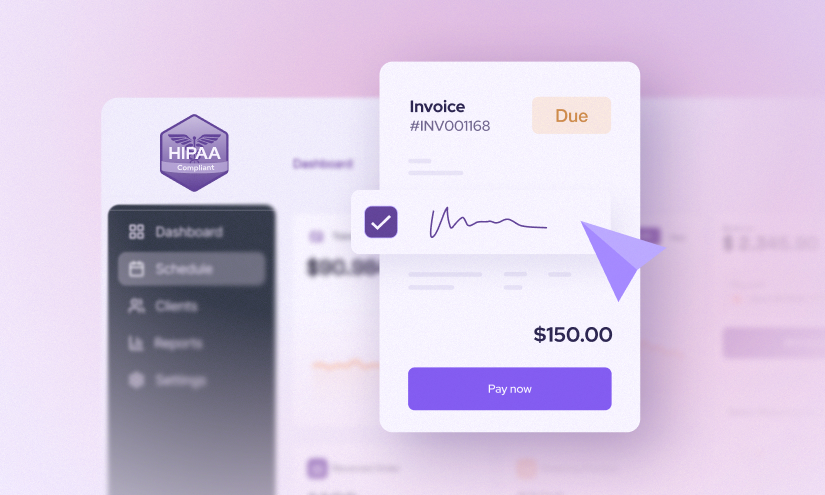
- Healthcare clinics can send Helcim HIPAA compliant invoices by email with a Pay Now button, so patients can pay by card, ACH, or an HSA/FSA card.
- Helcim's Customer Vault securely stores tokenized patients’ payment details, and costs nothing extra. Healthcare clinics can set up recurring payments or charge patients’ cards on file any time.
- Helcim Customer Portal lets patients login and see their invoice history, pay due invoices, and update saved payment information without calling the front desk.
- Clinics can use Helcim Fee Saver to pass the credit card processing fees to patients who choose to pay with credit cards.
- Helcim encrypts stored data with AES-256 and data in transit with TLS 1.2 or higher. Helcim is PCI DSS Level 1 compliant and charges $0 for PCI compliance.
Processing fees
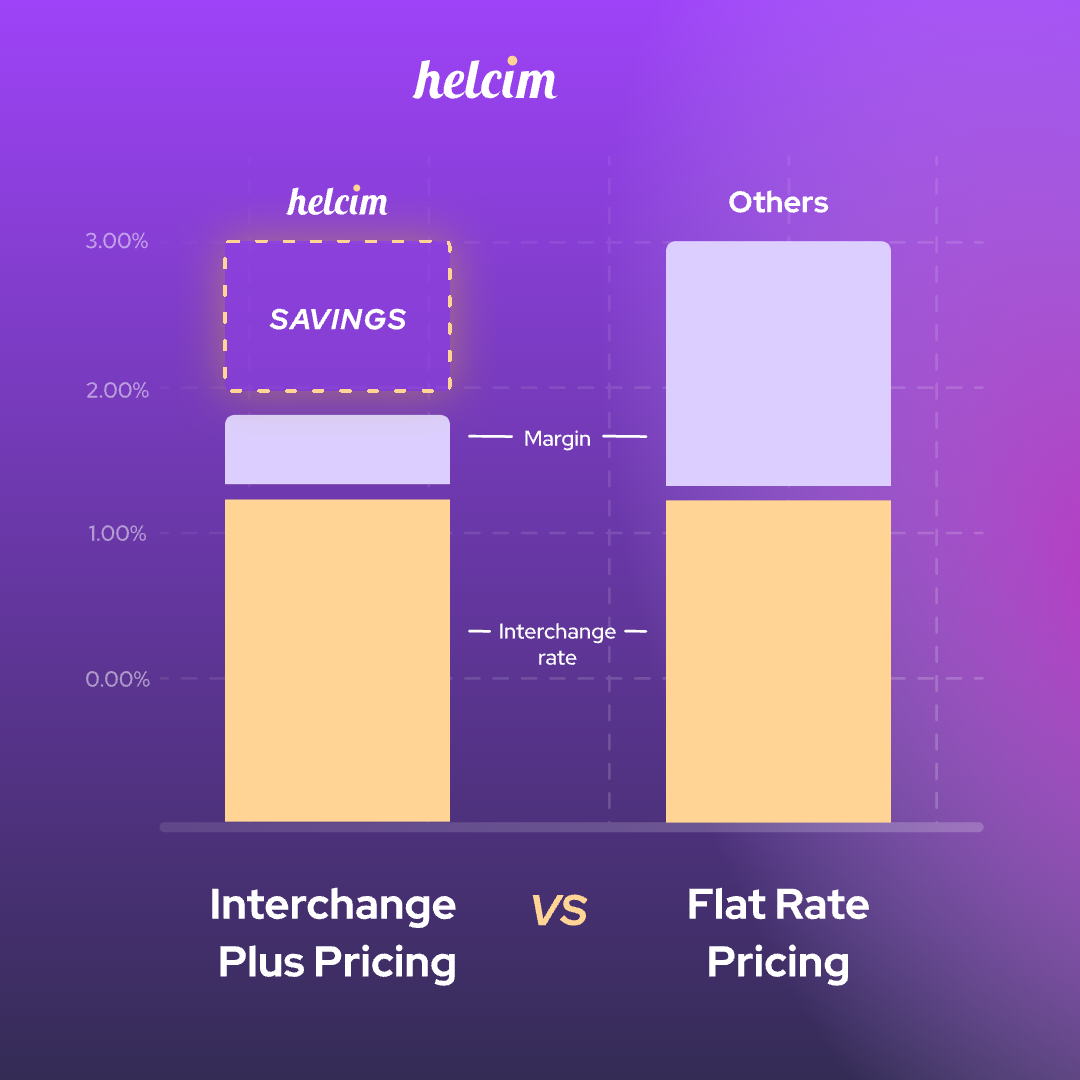
Helcim uses Interchange Plus pricing that pass the true payment processing fees to clinics:
- In-person: Interchange + 0.40% + $0.08
- Keyed/online: Interchange + 0.50% + $0.25
Because interchange-plus pricing causes the processing fee to fluctuate every transaction, Helcim's average rates are the easiest way to picture what you'll pay. For healthcare practices, the average on common credit cards (excluding American Express) is around 1.78% + 8¢ in person and 2.29% + 25¢ for keyed and online payments. Explore Helcim pricing here.
For ACH payments, Helcim charges 0.5% + $0.25 per transaction, capped at $6 for transactions under $25,000.
Strengths
- Helcim offers the automatic fee discount as clinics’ processing volumes increase. Healthcare clinics can reduce the fees up to 70% as they grow.
- Helcim doesn’t charge any monthly fee, setup fee, PCI compliance fee, or contract cancellation fee.
- Helcim offers affordable bank payments for large balances. Helcim ACH transfers in the U.S. and EFT payments in Canada cost 0.5% + 25¢, capped at $6 for payments under $25,000.
- Clinics can use Helcim Fee Saver to pass the credit card fees to patients to keep more margin on every service and care delivered.
- Helcim Payment Extension lets practices reduce EHR’s credit card processing fees without leaving the software.
- Helcim Invoicing software is available for both U.S. and Canadian practices. Helcim can settle in both USD or CAD. Besides, HSA and FSA card processing is available automatically for merchants with a healthcare merchant category code.
- Customer support is why many healthcare clinics love Helcim. Clinics can contact Helcim and talk with real humans via phone, email, and ticket.

Limitations
Helcim has no EHR, claims processing, or RCM functionality. Therefore, any healthcare practice that relies on insurance billing won’t find Helcim suitable for its business. However, healthcare clinics can connect EHR and billing platforms to Helcim via Helcim Payment Extension to get Helcim's low rates without sacrificing any insurance claiming features.
Who should choose Helcim
Helcim invoicing software is suitable for therapists, chiropractors, physiotherapists, and other practices that bill patients directly. Practices can get a free BAA, HIPAA-compliant invoicing, stored cards, and recurring payment plans without a monthly fee.
Also, Helcim offers affordable ACH payments (capped at $6 for transactions under $25,000), so clinics with big invoices can reduce processing fees by 3-4 times compared to credit cards.
If clinics currently use DrChrono, SimplePractice, Jane App, Tebra, or other platforms for billing and insurance claiming, they can connect it with Helcim Payment Extension to reduce the payment processing fees.
Athenahealth
AthenaOne combines clinical documentation, scheduling, practice management, medical billing, and patient engagement, with claims, payment posting, and revenue-cycle workflows built into the same platform.
Key features
- When a claim adjudicates, clinics can use Athenahealth’s Statement Pay to send the secure payment link via texts or emails, and the patient confirms their identity before the claim balance appears.
- Athenahealth’s AI Copay Prediction reads real-time eligibility responses and past payer decisions to estimate what the patient owes before the visit, and an OCR tool matches a photo of the insurance card to the right payer.
- Patients can set up an Autopay plan on a stored card (weekly, every two weeks, twice a month, or monthly) or a treatment plan that sends scheduled statement reminders, with an optional down payment.
Processing fees
Athenahealth currently doesn’t publish the payment processing fees on the website.
Strengths
- The clinical notes or progress notes completed in athenaClinicals fill the invoices with suggested codes, so your staff doesn’t have to re-key charges.
- Athenahealth connects more than 160,000 providers and processes over 315 million claims a year, and athenahealth makes more than 5,800 billing rule updates annually to catch payer-specific errors before submission.
- The athenahealth Marketplace lists more than 590 certified partner apps, including patient billing tools like InstaMed, Cedar, and Inbox Health.
Limitations
- Athenahealth charges a percentage of fees per collection but it doesn't publish that percentage, setup fees, add-on rates, or the card processing rates on the practice's merchant account.
- AthenaOne can generate invoices for employers, life insurance physicals, and legal records requests, but it doesn't have a feature to follow up or track collections on them, so your staff have to chase those balances manually.
- Athenahealth serves U.S. clinics only and has no Canadian clearinghouse connections or support for provincial plans like OHIP or B.C.'s MSP, and its licensing terms limit use to the United States.
Who should choose athenahealth
U.S. practices should choose Athenahealth if insurance is the main revenue source. AthenaOne puts coding, claim scrubbing, remittance posting, and patient billing in one system. However, other healthcare practices like therapists, med spas, or other practices that bill patients directly may not use all the features offered by Athenahealth.
DrChrono
DrChrono describes its own platform as a fully integrated medical billing and RCM system, including integrated payments, stored payment methods, mobile checkout, claims, clearinghouse connectivity, EHR and clinical charting tools.
Key features
- Healthcare practices can turn clinical forms into claims. The claims can be batched daily or twice-daily and transmitted through integrated clearinghouses like eProvider Solutions, TriZetto, and Change Healthcare.
- With the built-in Stripe payments, DrChrono Payments lets practices store tokenized cards, accept Apple Pay and Google Pay, and send payment links from the patient chart or the appointment calendar.
- DrChrono allows the healthcare practices to mail a paper statement with a QR payment code if the patients don’t respond to the statement emails or links.
- Healthcare practices can build recurring payment plans with minimum balance and minimum monthly payment, custom schedules, and down payments.
Processing fees
DrChrono uses Stripe as the integrated payment processing system so DrChrono’s payment processing fees may be similar to Stripe’s payment processing fees. DrChrono credit card processing fees can be 2.7% + 5¢ for in-person transactions, 2.9% + 30¢ for online transactions, and 3.4% + 30¢ for keyed-in transactions
Besides, DrChrono offers three different subscription plans, Foundation, Growth, and Premium. However, the pricing for each plan isn’t published. Healthcare clinics have to reach out to DrChrono for a custom quote.
Strengths
- The payment processing system is built into the charting and scheduling features so the staff can collect payments without walking back to the front desk. Staff can also take a payment from the Live Claims Feed while checking a claim's status.
- When patients ignore text or email statements, clinics can send paper statements with a QR payment code to patients.
- Clinics can get access to many crucial features like telehealth, the patient portal, Quest and LabCorp integrations, and ERA auto-posting.
- DrChrono can connect to QuickBooks Online and Xero for accounting and Phreesia and FormDr for intake.
Limitations
- DrChrono charges expensive credit card processing fees because it uses Stripe for the payment processing function. Healthcare clinics can connect DrChrono to Helcim via Helcim Payment Extension to reduce DrChrono credit card processing fees.
- DrChrono Payments adds a $5 monthly PCI program fee, a $50 monthly penalty if PCI self-attestation isn't completed, and a $30 non-refundable chargeback fee. In contrast, Helcim charges $0 for PCI compliance, and a chargeback fee of $15 that is refundable when merchants win the dispute.
- DrChrono charges extra usage fees, such as $1.00 per paper claim, $1.50 per workers' comp or auto claim, $30 per provider each month for extended lab access, and $0.05 per text over the plan's allowance. In contrast, Helcim invoicing is unlimited with no monthly fee or add-on fees.
- DrChrono isn’t a great fit for Canadian healthcare clinics because it bills and settles everything in USD and has no connection to provincial plans like OHIP (Ontario), AHCIP (Alberta), or MSP (British Columbia).
Who should choose DrChrono
DrChrono is a great fit for U.S. clinics that want charting, claims, and payments in one mobile app. It is also suitable for practices that bill insurance and want statement follow-up handled automatically.
If clinics love DrChrono’s features but want to reduce its credit card processing fees, they can connect Helcim to DrChrono using Helcim Payment Extension. With Helcim Payment Extension, clinics can process DrChrono payments using Helcim's low credit card processing fees without leaving the software.
Explore Helcim and DrChrono connection.
CareCloud
CareCloud describes its platform as combining EHR, practice management, billing, RCM, patient engagement, and analytics, supporting practices ranging from solo providers to larger, multi-location organizations.
Key features
- Healthcare clinics can use CareCloud Pay to send payment links to patients using text messages. The patients can verify their identity before they see any balance details. They can pay in full, pay part, or set a custom installment, and the payment posts to the matching claim automatically.
- CareCloud Breeze Check-in can handle pre-registration, check eligibility, and ask patients for copays or past balances before they reach the exam room.
- CareCloud Central uses CollectiveIQ engine to check claims against payer rules to verify claim eligibility before visits, and posts remittances in batches.
- CareCloud offers a contract management engine that stores each payer's fee schedule and compares it with what the payer actually paid. It can also flag underpayments, improper denials, and downcoding.
Processing fees
Currently, CareCloud doesn’t publish its payment processing fees on its website. Currently, CareCloud partners with Clover for in-person payment processing, so its in-person credit card processing fees may be similar to Clover’s 2.3%–2.6% + 10¢ per in-person credit card transaction.
Strengths
- Because CareCloud Pay reconciles each payment to the open claim, front-desk staff don't have to post patient payments by hand. Also, clinics can set up bulk reminders and let billing staff message a whole list of patients with balances at once.
- CareCloud helps clinics check claim eligibility, copay, and optional appointment prepayments so that practices can collect payments before care and reduce no-show rate.
- CareCloud Breeze Shop lets healthcare practices sell products and supplements with inventory tracking.
- CareCloud Concierge pairs the software with a billing team that handles charge capture, payment posting, and denials.
Limitations
- CareCloud doesn't publish payment processing rates and costs for products and plans. Healthcare clinics have to reach out to CareCloud for custom quotes.
- CareCloud requires standard agreements that last 12 months or longer, renew automatically each year, and need 90 days' written notice to cancel, while early-termination and data-extraction costs vary by contract.
- CareCloud doesn’t support Canadian clinics and provincial plans. In contrast, Helcim offers a HIPAA invoicing system for both U.S. and Canadian practices.
Who should choose CareCloud
CareCloud is a great fit for multi-provider and multi-location U.S. healthcare groups that want practice management, EHR, and billing in one place with reporting across locations and providers. It's most useful when insurance claims make up most of the revenue. CareCloud may not be a great fit for healthcare practices that set their own fees and bill patients directly.
How to verify if invoicing software is truly HIPAA compliant
Three things to check directly, rather than taking a "HIPAA compliant" label at face value:
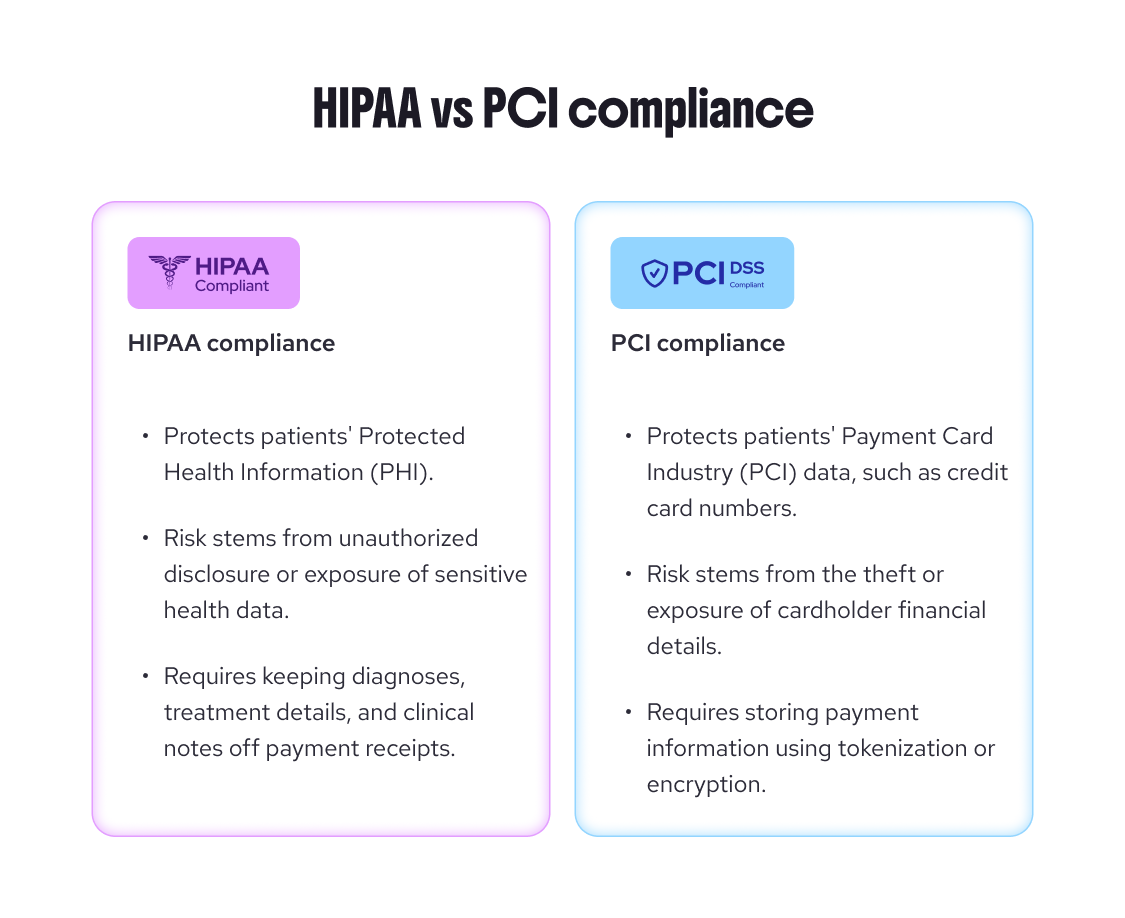
- Confirm a BAA is actually offered: HHS requires healthcare clinics to have a signed business associate agreement from invoicing software providers if they qualify as a business associate. The agreement must establish permitted uses, disclosures, and appropriate safeguards.
- Confirm what information the vendor will handle: HIPAA protects individually identifiable information relating to the provision of health care and payment for health care, so even billing information can constitute PHI, not just an invoice that lists a diagnosis. Use the minimum information necessary for the billing purpose, and ask the vendor exactly what data its invoicing workflow stores or transmits.
- Confirm PCI DSS separately from HIPAA: The HIPAA invoicing software must also comply with PCI DSS compliance to protect the patient's card details.
What are must-have security features in HIPAA-compliant invoicing software?
HIPAA-compliant invoicing software needs to have various security features, such as encryption, tokenization, role-based access control, and audit logging:
- Invoice and payment data should be encrypted and unreadable both while it's stored and while it moves across the network.
- HIPAA compliant invoicing software needs to tokenize the stored payment data. This technique replaces the card numbers with tokens, which ensure PCI compliance.
- Role-based access management helps healthcare clinics set different permission levels for staff members. This feature makes sure only key staff can access patients' sensitive information.
- The audit logging helps healthcare clinics keep a record of which staff accessed or sent an invoice, and when.
- Documented incident response procedures are also important. The HHS requires invoicing software providers to have procedures for identifying, responding to, and documenting security incidents, so it's worth confirming the vendor has an equivalent process in place.
Ready to send invoices without overpaying or overexposing patient data?
Helcim's Online Invoicing offers a BAA to healthcare merchants on request, tokenized card storage, and payment links, all without requiring a switch to a full EHR system. Start for free or request your BAA directly from the compliance team at privacy@helcim.com.
Already running an EHR or practice management platform? Check whether it's on Helcim's Payment Extension list before making any changes.
Best HIPAA Compliant Invoicing Software for Healthcare Providers FAQs
Are BAAs required for invoicing tools?
Generally yes, when the vendor qualifies as a business associate because it creates, receives, maintains, or transmits PHI on behalf of a covered entity. Billing and payment information relating to an identifiable patient's health care can itself be PHI, so don't assume an invoice falls outside HIPAA simply because it doesn't include a diagnosis. When in doubt, confirm directly with the vendor and request a BAA before onboarding.
What happens if my online invoicing provider causes a PHI breach?
Under HIPAA's Breach Notification Rule, a business associate must notify the covered entity of a breach of unsecured PHI, while the covered entity has its own separate notification obligations to affected individuals and to HHS. Your BAA should spell out the vendor's breach-notification obligations and timing, but business associates also carry direct legal obligations under HIPAA independent of what the BAA says. Confirm your vendor's breach notification process before a problem occurs, not after.
Does using HIPAA compliant invoicing software automatically make my practice compliant?
No. A compliant vendor and a signed BAA address the vendor's side of the relationship, but your practice still holds its own HIPAA responsibilities around staff training, minimum-necessary data handling, and appropriate safeguards. Using a compliant business associate doesn't outsource your practice's own compliance obligations.